

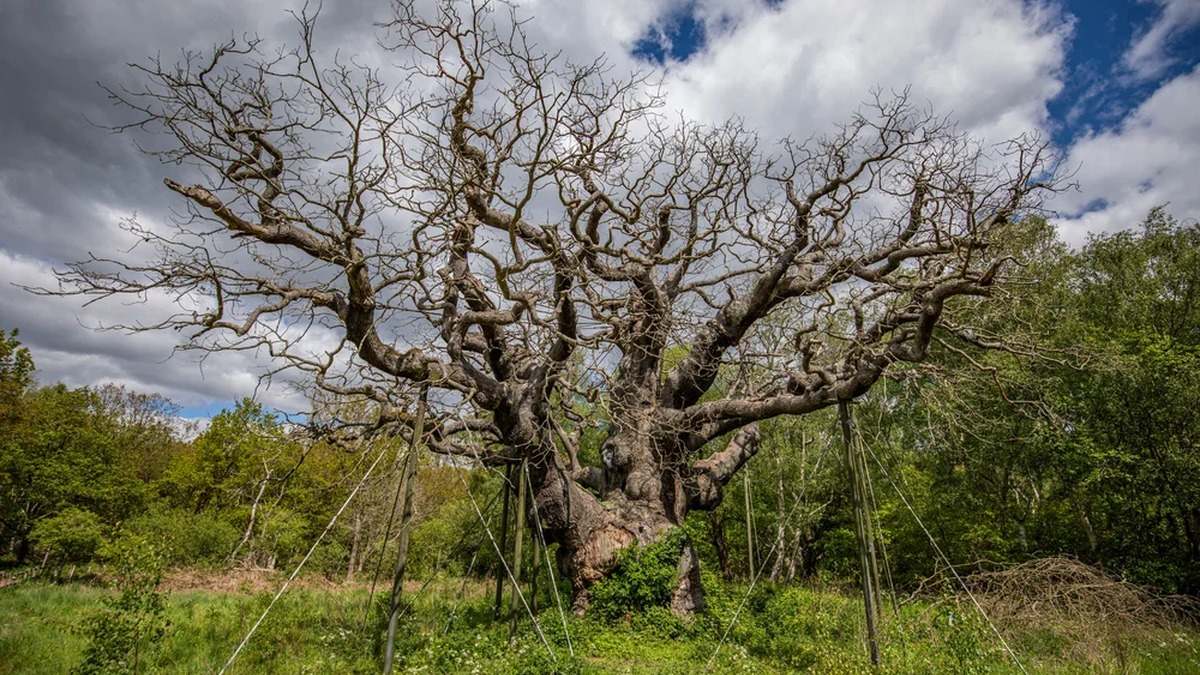

The Major Oak has died in Sherwood Forest, Nottinghamshire, after the ancient tree failed to produce leaves this spring, the Royal Society for the Protection of Birds said.
The RSPB, which manages Sherwood Forest, said scientific experts considered the tree dead after its first spring without leaves. The oak lived for up to 1,200 years and had a trunk circumference of 11 metres.
The charity said experts could not identify one exact cause of death. It cited structural interventions, heavy visitor activity, heatwaves and droughts as major pressures on the tree.
Visitor footfall compacted the soil around the Major Oak, according to the RSPB. The charity said that made it harder for rainwater, oxygen and nutrients to reach the roots.
Early preservation work also placed supports under large branches. The RSPB said those efforts likely contributed to the oak’s decline over time.
Reg Harris, who monitored the tree’s health for the RSPB, linked its recent decline to five hot and dry summers. He also cited the United Kingdom’s July 2022 record temperature of 40 degrees Celsius.
The Major Oak drew millions of visitors because of its age, size and links to Robin Hood folklore. Legend says Robin Hood used its hollow trunk as a hideout.
Read: Project Bellweather Mosquitoes Tested as Biological Weapon
The tree was named after Major Hayman Rooke, a former British Army soldier and local historian. His 1790 book helped bring tourists to Sherwood Forest.
The RSPB said the Major Oak will remain standing as a monument for visitors and wildlife. Saplings from the tree have also been planted worldwide.
Dame Judi Dench, a Woodland Trust patron and ambassador, called for stronger legal protections for ancient trees. Woodland Trust adviser Ed Pyne told the BBC that lessons from the Major Oak could help protect other ancient trees.



