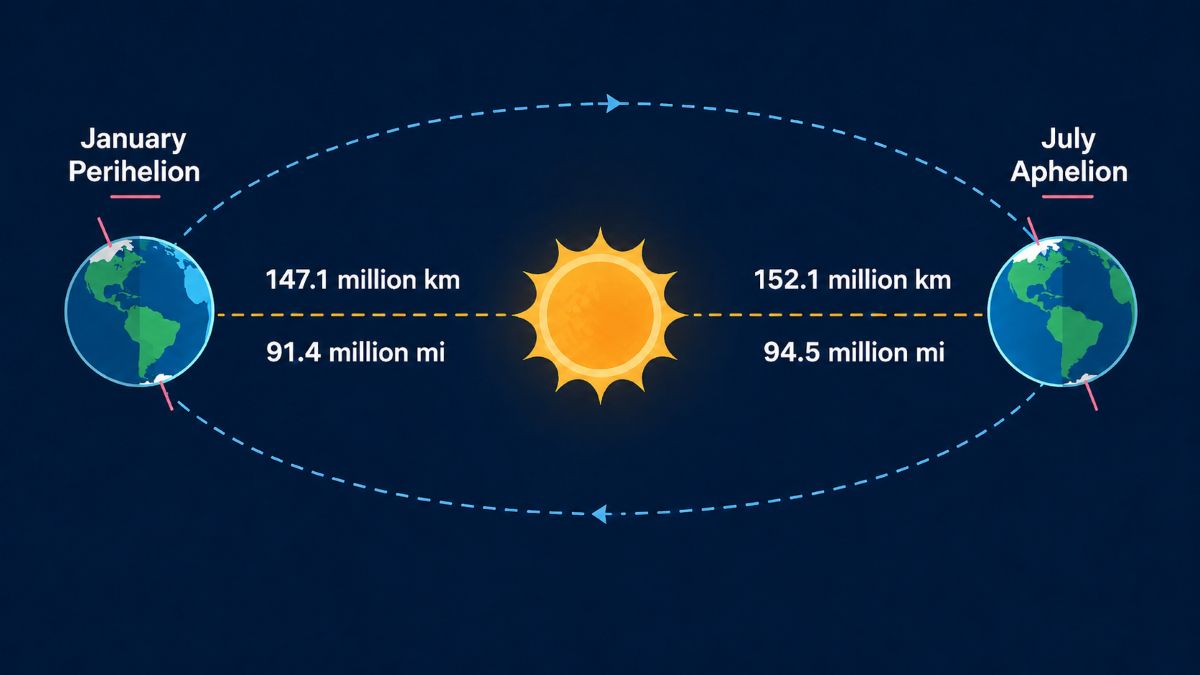

Earth’s aphelion in 2026 will occur on July 6, when the planet reaches its farthest point from the Sun, the Moscow Planetarium told TASS.
The planetarium said Earth will be 152,093,251 kilometres from the Sun during the annual orbital event. That equals 1.0167 astronomical units.
Earth’s orbital speed will slow to between 29.27 and 29.29 kilometres per second at aphelion, according to the planetarium.
The change occurs because Earth orbits the Sun in an ellipse. The planet moves faster when it is closer to the Sun and slower when it is farther away.
At perihelion, Earth’s closest point to the Sun, its orbital speed rises to between 30.27 and 30.29 kilometres per second.
The planetarium said the Sun’s apparent diameter will also reach its smallest point of the year during aphelion.
The event does not cause summer in the Northern Hemisphere, according to the science note. Earth’s seasons depend mainly on its 23.5-degree axial tilt, not its changing distance from the Sun.
Read: Total lunar eclipse Pakistan timings and visibility guide
In July, the Northern Hemisphere tilts toward the Sun. That tilt brings longer days and more direct sunlight, while the Southern Hemisphere experiences winter.
Earth’s distance from the Sun changes by about 3.4% during the year, the note said.