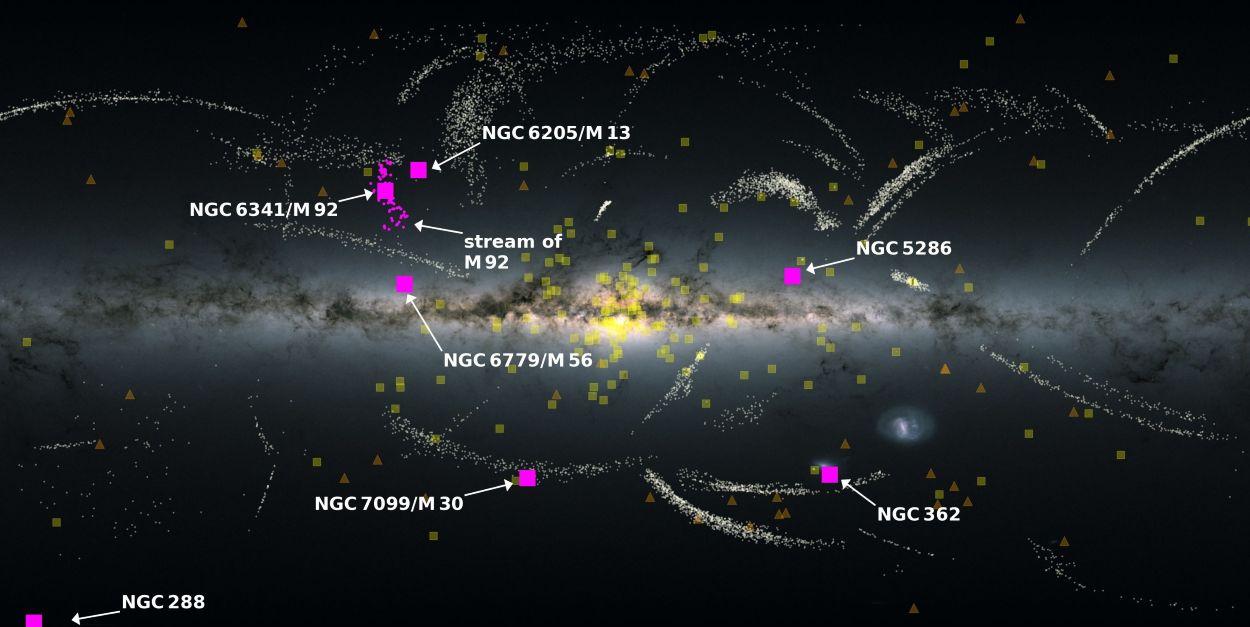

Astronomers may have found Milky Way Loki galaxy remnants in 20 ancient stars near the galactic disk, according to a study in Monthly Notices of the Royal Astronomical Society.
The team, led by Dr Federico Sestito of the University of Hertfordshire’s Centre for Astrophysics Research, studied very metal-poor stars. Such stars can preserve clues from the early universe.
The researchers used European Space Agency Gaia data and the Canada-France-Hawaii Telescope on Maunakea, Hawaii. The stars sit about 7,000 light-years from the solar system.
The stars share similar chemical signatures, yet they move in different directions around the Milky Way. Eleven follow the galactic disk’s rotation, while nine move against it.
Sestito said that pattern could fit a merger when the Milky Way was younger and smaller. Simulations suggest the event happened no later than 3 billion to 4 billion years after the Big Bang.
Read: SpaceX Musk Pay Package Tied to Mars Colony Goal
Dr Hans-Walter Rix of the Max Planck Institute for Astronomy said the chemical fingerprints offered the strongest evidence for a shared origin. He did not take part in the study.
Researchers said another explanation remains possible. The stars could come from multiple mergers, so larger datasets will need to test the Loki scenario.