

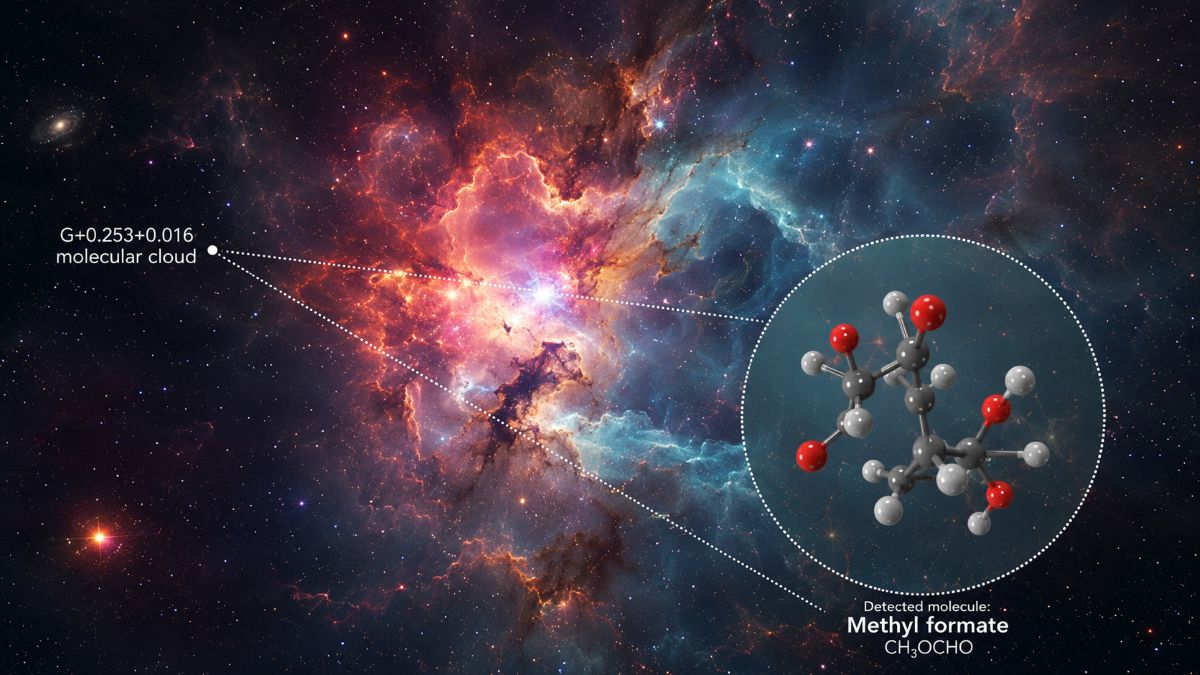

Astronomers have detected erythrulose sugar in interstellar space for the first time, identifying the four-carbon molecule in cloud G+0.693−0.027 near the Milky Way’s centre.
The peer-reviewed discovery was published in Nature Astronomy on July 13, 2026. Researchers used broadband observations from Spain’s Yebes 40-metre and IRAM 30-metre radio telescopes.
The team identified 12 spectral line sets corresponding to 17 molecular transitions. Six were predominantly free from interference, and the researchers calculated a 0.2% probability that their alignment occurred by chance.
Erythrulose appeared at least eight times more abundant than comparable three-carbon sugars, including glyceraldehyde and dihydroxyacetone, which the survey did not detect.
Chemical models indicated that the molecule can form without biological activity on cold interstellar dust grains. The proposed reaction combines compounds related to glycolaldehyde and ethylene glycol.
Lead author Izaskun Jiménez-Serra is a researcher at the Centre for Astrobiology, operated by Spain’s CSIC and INTA. She said the detection suggested sugars could be more widespread in interstellar space than previously believed.
Erythrulose occurs naturally in raspberries and is also used in self-tanning products. Its detection does not indicate extraterrestrial life, but it shows that molecules relevant to prebiotic chemistry can form before planets emerge.
Read: Milky Way Loki Galaxy Remnants Found In 20 Stars
The study said interstellar erythrulose could have entered developing planetary systems through comets, asteroids or other material inherited from ancient molecular clouds. Researchers now plan to search for more complex sugars.



