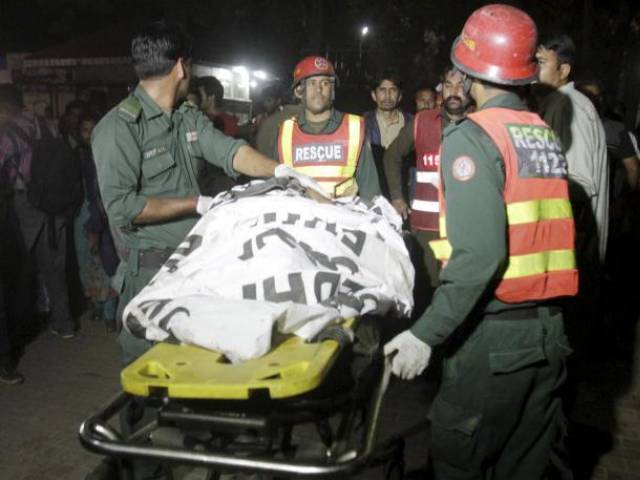

Shakeel Anjum spent Easter Monday burying six victims of the wanton slaughter in Lahore when a suicide bomber attacked a park full of children.
The pastor’s voice is heavy after presiding over service after service for Christian victims of Sunday’s carnage when the bomber blew himself up in a park crowded with families enjoying the warm Easter evening.
The blast sent ball bearings ripping through children, killing 72 people while wounding scores more. The Pakistani Taliban faction that claimed the attack said it had targeted Christians.
Anguished families spent Easter Monday burying their dead, bent over coffins in grief.
He tells AFP that the six people that Anjum buried lived within the same two blocks of Lahore’s Youhanabad area, clutching a black-covered Bible in his hands.
“We are such a loving community in the country of Pakistan,” he says, referring to the country’s Christian minority, which is believed to make up around 1.6 percent of the estimated population of 200 million.
Christians are frequently the target of militant attacks in Pakistan, including a double suicide bombing that killed 82 people at a church service in Pakistan’s northwestern city of Peshawar in 2013 and church attacks in Lahore in 2015 that killed 17.
They also often face discrimination at work and routinely fall victim to the blasphemy laws, which rights groups say are often used to wage personal vendettas.
“We need much consolation,” Anjum, pastor of the Children’s Chapel in Youhanabad, says. “We have become tired, we are worried, have become scared.
“See, we pray that this country should remain safe forever. We are Pakistanis; we love Pakistan.”
He says that Christians were hurt in Sunday’s attack because it took place on Easter — but there were also Muslim victims. “Our Muslim brothers… those families are crying too.
“We are all being hit by this, Christians and Muslims also.”
Among those he buried was Mutahir Javed, who was in his 20s.
“I tried to pump my son’s chest and give him CPR, but he was no more. He died before me,” Mutahir’s father, Javed Bashir, tells AFP as relatives wail around him.
Anjum also buried Salamat Masih in his 20s, whose mother had to be restrained by other women in her grief.
“My son, my son, nobody should lose their sons,” she sobs.
“Doing so many funerals, it’s my job, but my heart doesn’t feel good,” Anjum says.
He says you don’t think about funerals when you become a pastor. Instead, you think about the Bible and taking its message to the world — life, not death.