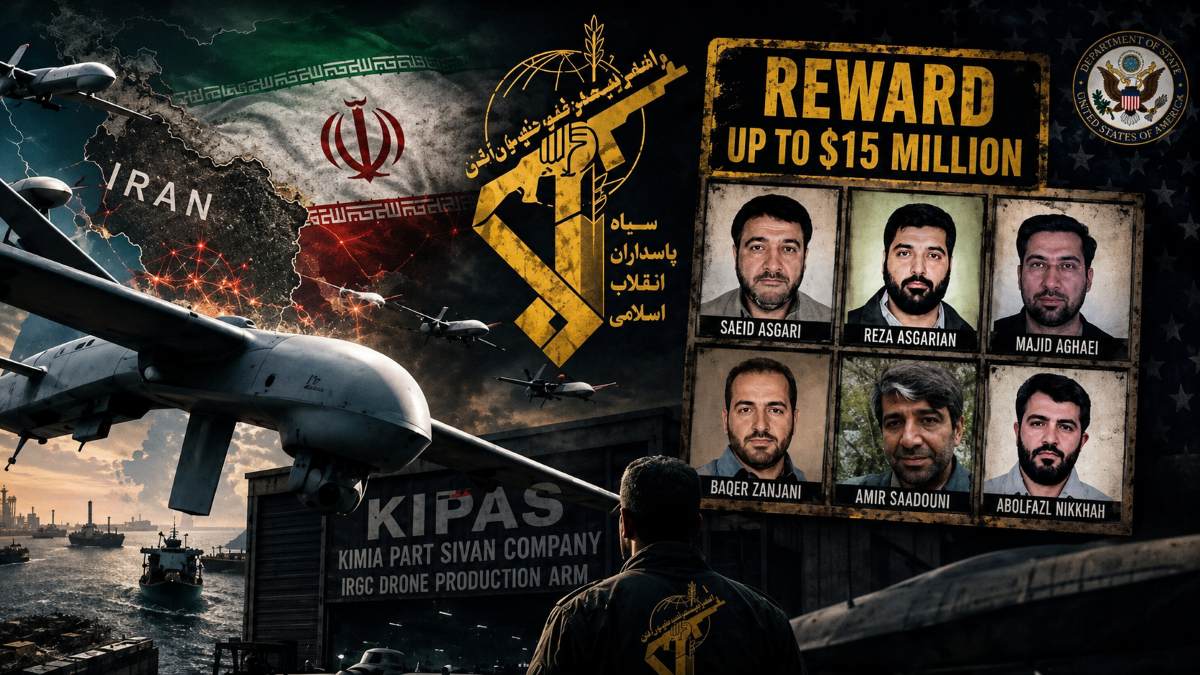

WASHINGTON: The IRGC financial reward remains at up to $15 million as the United States intensifies sanctions against networks it says finance Iran’s Islamic Revolutionary Guard Corps.
The State Department’s Rewards for Justice program currently lists the offer for information that disrupts IRGC financial mechanisms, including those linked to the IRGC-Quds Force. However, the reward is not new. Washington first announced the $15 million framework on September 4, 2019.
The program seeks information about revenue sources, oil-for-money schemes, front companies, sanctions-evasion networks and financial facilitators.
Current Rewards for Justice pages also apply the framework to networks involved in procurement of technology and equipment for IRGC-linked military programs.
Meanwhile, the U.S. Treasury expanded its separate Operation Economic Outcast campaign on September 17 by sanctioning Iranian digital-asset exchange BitBank, its developer and three associates of financier Babak Zanjani.
Read: US Offers $15 Million Reward Over IRGC Drone Network
Treasury alleged that Zanjani used BitBank to transfer hundreds of millions of dollars in Bitcoin to the IRGC between June and July. Those assertions are U.S. government allegations underlying the sanctions action.
Read: Iran Sanctions Pressure Cannot Topple Regime Alone: Expert
The active reward program is part of Washington’s broader effort to target oil sales, sanctions evasion, cryptocurrency channels and financial networks.
The Treasury announced Operation Economic Outcast in August 2026. Treasury also used the campaign on September 10 to sanction networks it said supported Kata’ib Hezbollah and Lebanese Hezbollah.
The IRGC financial reward therefore operates alongside, but separately from, Treasury sanctions. Rewards for Justice pays for qualifying information, while the Office of Foreign Assets Control can designate individuals, businesses and assets under U.S. sanctions authorities.