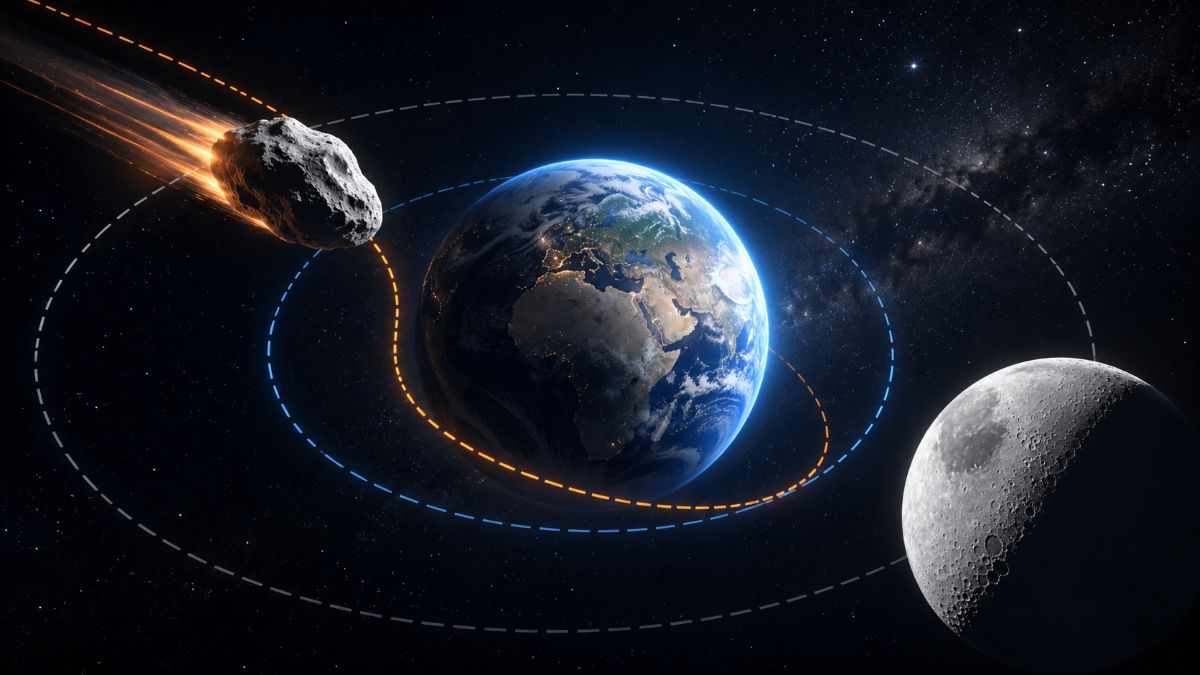

New visibility maps indicate that the Apophis flyby on April 13, 2029, could be seen from regions containing about 90% of the world’s population.
Scientists presented the maps at the Apophis T-3 Years workshop at the University of Padua in Italy. Actual visibility will depend on darkness, cloud cover and local light pollution.
The asteroid, officially named 99942 Apophis, will pass about 32,000 kilometres above Earth’s surface. That will place it closer to the planet than many geosynchronous satellites, according to the National Aeronautics and Space Administration.
NASA estimates that Apophis is about 340 metres wide. The agency says observers in the Eastern Hemisphere will be able to see it without a telescope or binoculars during the close approach.
The newly presented maps show the viewing period beginning around 15:00 UTC over Australia and much of Asia. Apophis is expected to reach its greatest apparent brightness at about 20:35 UTC before making its closest approach at approximately 21:45 UTC.
Viewers should expect a moving point of light rather than a fiery meteor. Richard Binzel, a professor of planetary sciences at the Massachusetts Institute of Technology, said the asteroid would cross the sky more slowly than a typical satellite.
Read: Hayabusa 2 Probe Flies by Asteroid Torifune
NASA has ruled out an Apophis impact for at least the next 100 years. Its OSIRIS-APEX spacecraft will study the asteroid after the flyby to examine how Earth’s gravity affected its surface, rotation and orbit.