

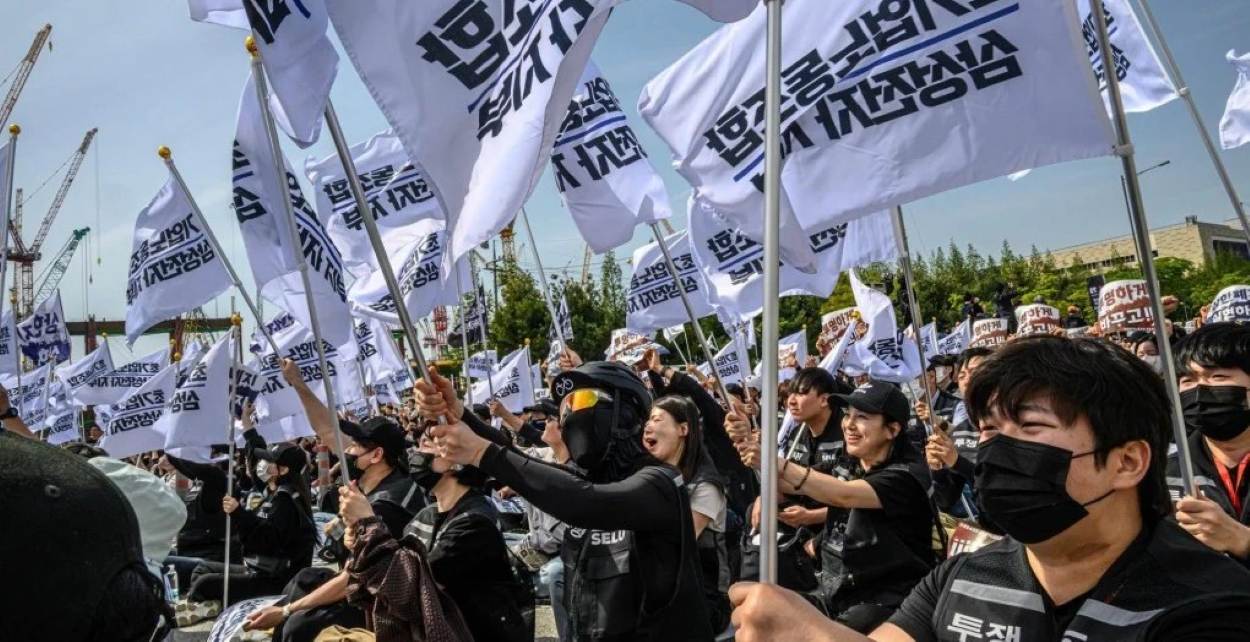

Seoul: South Korea plans emergency measures to prevent a labour strike at Samsung Electronics, the world’s largest memory chip maker, Prime Minister Kim Min-seok said on May 17, 2026.
The semiconductor union, representing tens of thousands of workers, threatened an 18-day strike starting May 21 after pay talks collapsed.
Workers demand 15% of operating profits as performance bonuses, while Samsung offered 10% plus special bonuses.
“Just one day of suspension at Samsung’s semiconductor factory could incur losses of 1 trillion won (~$667.68 million),” Kim said.
He added that a temporary pause in production lines could lead to months of downtime, raising total economic risk to 100 trillion won (~$66.8 billion).
Samsung accounts for 22.8% of South Korea’s exports and 26% of the domestic stock market. The company employs more than 120,000 people and works with 1,700 suppliers, Kim noted.
Emergency arbitration, rarely invoked, allows the labour minister to ban strikes for 30 days while the National Labour Relations Commission mediates and arbitrates. The union pledged to negotiate in good faith on May 18.
Analysts warned that a strike could disrupt global memory chip supply chains, affecting AI data centres, smartphones, and PCs. Rivals such as SK Hynix could benefit from any production halt.
Samsung and the government hope to reach an agreement before May 21 to avoid unprecedented economic and market disruption.
South Korea is preparing for an emergency arbitration to prevent a Samsung labour strike that could halt semiconductor production and cause up to $667.68 million in losses per day.



