

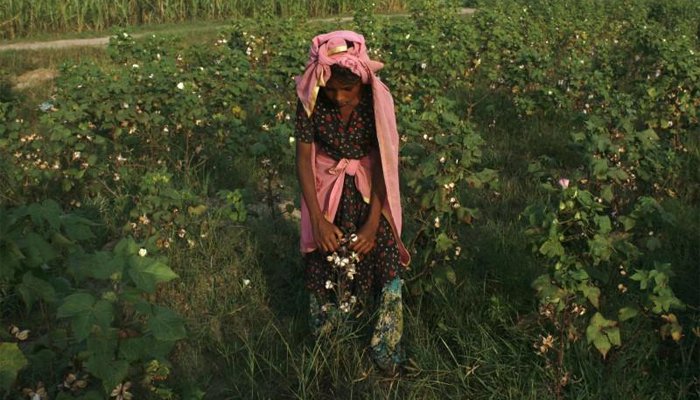

Widow Amina Batool has laboured in Pakistan’s scorching cotton fields for nearly eight years to eke out a living and feed and clothe her two children.
She lives in a two-room, mud-thatched house on the outskirts of Vehari town, in Pakistan’s Punjab cotton belt, surrounded by shrubs and eucalyptus trees, where she rests with her daughter and son after her long working days in searing temperatures.
At first, Batool, 32, thought cotton picking would bring her a reliable income after the death of her husband in 2009. But she was unaware of the health risks the work posed.
She has been suffering from recurring headaches, skin, and eye ailments since she started cotton picking, and can spend as much as a third of her $80 monthly income on health bills.
“Every season, I suffer problems when I return home after cotton picking. But I cannot abandon the job because my two children depend on me,” she told the Thomson Reuters Foundation.
Women labourers make up the bulk of the estimated half a million cotton pickers in Pakistan — the world’s fourth biggest cotton producer. With the widespread use of pesticides and a lack of safety equipment, Batool’s story is familiar to many of them.
Pakistan’s government and provincial authorities say they are taking steps to ensure the use of safety gear, but women’s rights groups say nothing is done when farm owners don’t comply.
“Taking measures at official levels … is a welcome move. But … punishing with jail-terms and imposing fines upon those who fail to comply are a must for successful enforcement,” said Shaista Bukhari — the executive director of Women’s Rights Association Pakistan.
Cotton is picked by hand and at the end of the day, women labourers carry their bundles of blooms to be weighed, to determine how much they will be paid. Complaints of health problems — which experts blame on pesticides — are widespread.
“A huge number of the cotton pickers carry out cotton-picking without wearing safety gadgets such as gloves, face masks, aprons, glasses, head and arm covers,” said Khuda Bakhsh — an agriculture scientist and a lead author of a study on the hazards of cotton harvesting to be published in November.
“Complaints of the skin irritation, headache, nausea, gastroenteritis, general weakness, dizziness, sleeplessness, vomiting, coughs, fever, and stomach pain are rampant among women cotton pickers,” he told the Thomson Reuters Foundation.
Poorly enforced
There are two laws dating back to the 1970s governing pesticide use and ensuring health protection of farm workers from possible exposure to pesticides.
Nazar Gondal — the former federal agriculture minister — said they were poorly enforced.
“Such laws remain unimplemented, mainly due to weak institutions and laxity on the part of the agriculture and environmental protection departments,” he told Thomson Reuters Foundation in a telephone interview.
Farm owners, however, blame the workers for not wearing masks and gloves provided for cotton picking.
Agri Forum Pakistan chairman Ibrahim Mughal said his farmers’ organization had run programs to encourage farmers to demand their workers wear protective clothing, but with little success.
“We have organized over three dozen awareness-raising programs for cotton field owners and cotton pickers in collaboration with local non-government organizations in Punjab and Sindh provinces and encouraged farmers to make it mandatory for their workers to wear protective clothing,” he said.
“But such efforts have failed to produce good results.”
However, Pakistan’s National Food Security and Research Minister Sikandar Hayat Khan Bosan said discussions with the provincial agriculture departments on the rights of cotton pickers had made good progress.
“Provincial agriculture secretaries have finally been convinced that sensitizing cotton field owners about the rights of cotton picking workers to safety equipment … is key,” he told the Thomson Reuters Foundation.
In June, the Punjab provincial agriculture department launched a program to enforce the provision of safety equipment to cotton pickers. Others provinces should follow suit, Bosan said.
However, Zohra Yusuf — the head of the Human Rights Commission of Pakistan and a women’s rights activist — was not optimistic that much would change.
“The protection of (rural women‘s) educational, health, employment and maternal rights remain the … lowest priority of the political leaders and policymakers,” she said.
Back in Punjab, widow and mother-of-two, Amina Batool said she has no choice but to carry on picking cotton.
“I have no skills, I have to rely on manual labour to feed my family. I cannot let my children sleep on empty stomachs,” she said.
“If my employer gives me protective equipment that would be a great relief — at least it would save us spending on health bills.” (Reuters)



