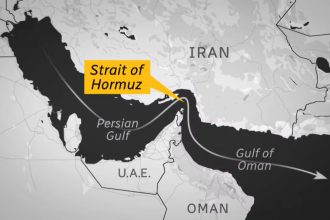
Iran’s Islamic Revolutionary Guard Corps (IRGC) Navy rejected US claims of control over the Strait of Hormuz. Political deputy commander Ali Mohammadi argued that oil markets contradicted Washington’s account.
Mohammadi questioned why markets had not reacted differently if oil shipments and commercial vessels were passing as Washington claimed.
“Because the market also understands that you are lying,” he said, addressing U.S. President Donald Trump.
However, US Central Command (CENTCOM) said American forces and regional partners controlled the waterway. It maintained that vessels carrying commercial goods and energy supplies continued to pass through.
Read: Iran Air Defences Hit Aircraft Over Qeshm, Media Say
Mohammadi also challenged Washington’s assertion that American forces had destroyed the Iranian naval force. He asked why US forces remained 600–700 kilometres away rather than approaching the strait.
Meanwhile, he claimed the IRGC Navy retained oversight of vessel movements through the Persian Gulf, the strait and the Gulf of Oman.
Read: Iran-US Talks: Rezaei Says Trump Cannot Decide on Terms
Iranian naval official Ali Mohammadi challenged Washington’s claims about control and commercial traffic through the Strait of Hormuz.
He questioned Washington’s claim that it had severely weakened Iran’s naval capabilities in the area. He asked why US warships remained 600–700 kilometres away in the Indian Ocean instead of escorting vessels through the narrow waterway.
Read: US-Iran Talks Set for Separate Qatar Meetings in New York
Iranian officials frequently use the stability of the Strait of Hormuz to project power and stability, asserting that the IRGC successfully secures the waterway and that Western-led warnings about security risks are merely political theatre or propaganda.
Conversely, Donald Trump and various U.S. administrations have historically emphasised the threat Iran poses to international shipping lanes, pointing to past incidents of tanker seizures, mine deployments, and drone strikes in the region as evidence of a persistent security risk that justifies strict economic sanctions and a strong foreign military presence.