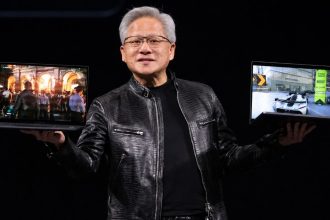



Nvidia chief executive Jensen Huang expects physical artificial intelligence (AI) to drive the technology’s next major advance, enabling robots and other machines to interpret their surroundings and perform tasks.
Nvidia describes physical AI as a way to combine artificial intelligence with cameras, sensors and robotic systems. It aims to help machines respond to changing environments without needing separate instructions for every movement. Applications extend beyond humanoid robots.
For autonomous vehicles, the approach could support predictions about a pedestrian’s movements. In warehouses, robots could use it to move around workers and handle items without depending entirely on predetermined routes.
Factories and hospitals are among the other settings exploring its potential.
However, teaching machines how objects move and interact remains a technical challenge. Unlike an incorrect chatbot response, a mistake involving physical movement can damage equipment or injure someone.
Read More: Jensen Huang X Strategy Turns Nvidia CEO into AI Explainer
Nvidia is developing simulation tools to help address that problem. These tools let developers train and evaluate robotic systems in virtual settings before testing them in the physical world.
Its Cosmos models support that work by generating scenarios and synthetic training data involving physical environments. According to Nvidia, developers can use this material to train and assess robotics and autonomous-driving systems.
Simulation provides a place to test different situations, but the company’s development goals do not establish that machines can safely handle every real-world task.
Huang’s vision is for AI to progress from supplying information to carrying out actions. Technical performance, safety and cost remain obstacles to wider adoption.