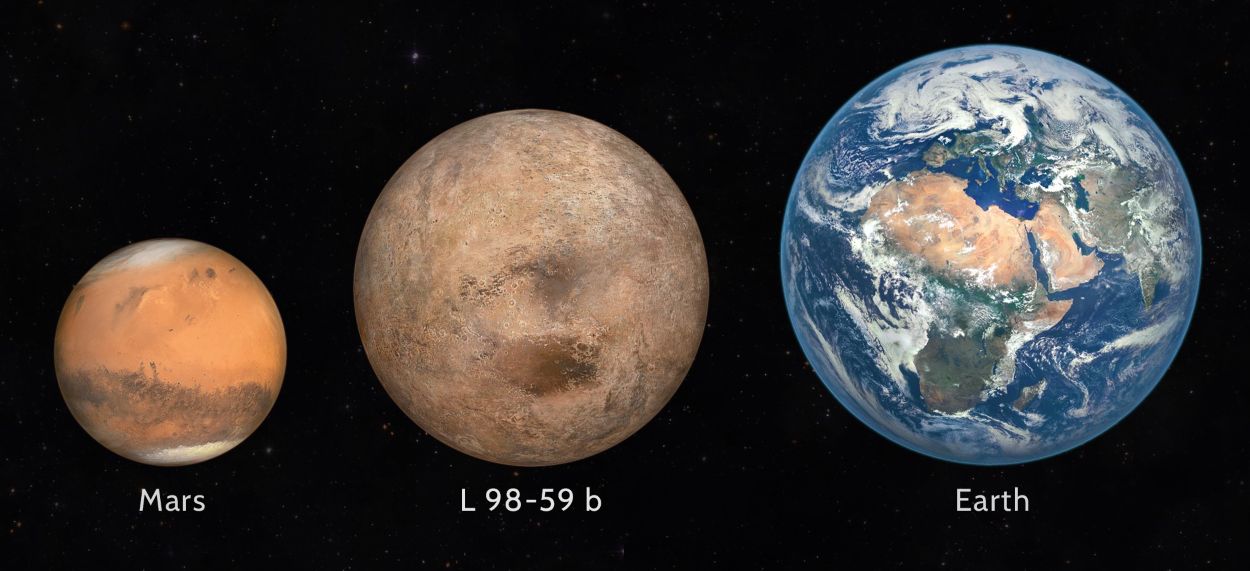

The L 98-59 d magma planet may be one of the strangest worlds yet identified near Earth. Astronomers say the planet, located about 34 to 35 light-years away in the constellation Volans, appears to be covered by a deep global magma ocean and wrapped in a hot, sulfur-rich atmosphere that keeps its surface molten.
According to the journal title Nature Astronomy and the newly reported study, L 98-59 d is more than 60% wider than Earth but far less dense. Researchers say its interior may be dominated by a single deep, mushy magma layer rather than the distinct crust and mantle structure seen on Earth.
The planet was first discovered in 2019. Later observations from the James Webb Space Telescope and ground-based facilities helped scientists build a new picture of its atmosphere and interior evolution over billions of years.
Why L 98-59 d magma planet still molten
Researchers say L 98-59 d has remained molten because its atmosphere traps heat in a runaway greenhouse effect. That thick atmosphere is thought to be mostly hydrogen but unusually rich in sulfur compounds, including hydrogen sulfide, which has a rotten-egg smell.
The study suggests the planet’s magma ocean extends thousands of miles deep and makes up most of the planet’s interior. Scientists also say the metallic core appears relatively small compared with Earth’s.
This is not simply a case of the planet sitting too close to its star. The study says its hot atmosphere plays the leading role, while stellar radiation and gravitational interactions with neighbouring planets add further heating.
A sulfur-rich atmosphere, unlike anything in the solar system
The atmosphere of L 98-59 d is one of the main reasons the planet stands out. Researchers say about 10% of it may be hydrogen sulfide, pointing to a sulfur-rich interior and a mineral makeup unlike that of the rocky planets in our own solar system.
That combination of a molten surface and sulfur-laden air may place the world in a category of its own, at least for now. Current reporting on the study says astronomers see it as a possible new class of exoplanet rather than a typical rocky or water-rich world.
The answer appears to be no; however, researchers say the planet’s surface temperature exceeds 1,500 degrees Celsius, making it far too extreme to support life as we know it.
Still, the discovery matters because it expands the range of worlds scientists now know exist. As exoplanet research advances, planets like L 98-59 d are showing that nearby star systems can contain environments far stranger than earlier models predicted.