

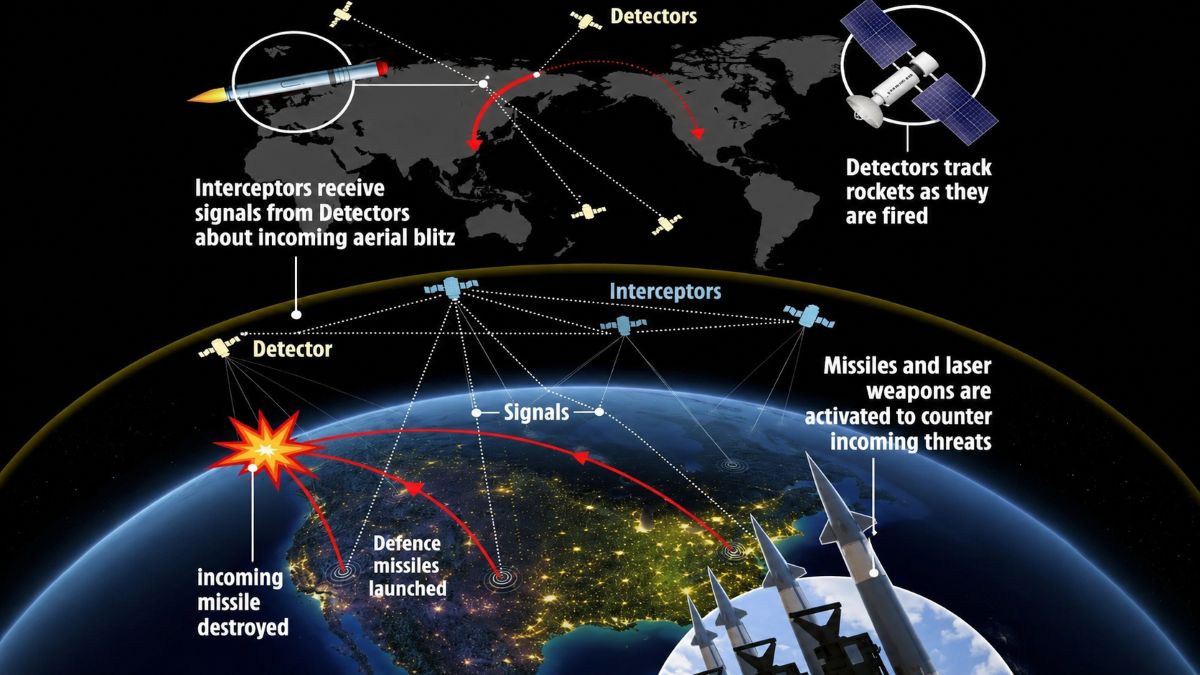

Golden Dome interceptors designed to destroy long-range missiles during launch face severe limits from flight time, satellite mass and coverage requirements, according to a technical analysis.
U.S. President Donald Trump directed the Pentagon in January 2025 to develop the Golden Dome missile-defence system.
The plan includes space-based interceptors intended to hit ballistic missiles during their boost phase, before they release warheads and decoys.
In April 2026, the Pentagon awarded 12 companies a combined $3.2 billion to begin developing boost-phase defence concepts.
Booz Allen Hamilton has publicly described one proposal, called “Brilliant Swarms.” Its concept uses 2,000 interceptor satellites, each weighing about 40 to 80 kilograms, operating at altitudes of 300 to 600 kilometres above Earth.
However, the analysis calculates that a workable kill vehicle alone would weigh about 95 kilograms before adding the large rocket booster needed to reach a missile during its brief launch phase.
Long-range missiles typically burn their engines for only about three minutes. That leaves interceptors little time to detect a launch, calculate a firing solution and reach the target before booster shutdown.
Read: Golden Dome Space Interceptors Team Named by Anduril
Using Booz Allen’s proposed orbital layout, the analysis estimates that each complete interceptor satellite could instead require a mass of about 20 tons under an aggressive zero-decision-time scenario.
Providing two interceptors against each missile in a five-missile salvo could require roughly 4,000 satellites totalling about 80,000 tons in orbit, according to the calculations.
Read: US Seeks $18.2 Billion to replenish Iran War Interceptors – Bloomberg
A different orbital design would require about 21,000 interceptors to defend against five missiles. That constellation would place about 24,000 tons in orbit.
Low-Earth-orbit satellites would also need regular replacement because atmospheric drag gradually lowers their orbits, with estimated replacement cycles of roughly four to five years.
Read: US Munitions Stockpile Leaks Prompt Trump Investigation
U.S. Space Force General Michael Guetlein, who heads Golden Dome, has told Congress that the military would not produce a space-based boost-phase system if it proved unaffordable or impossible to scale.



