
For much of the last week, the U.S. aircraft carrier Carl Vinson has been patrolling the South China Sea. It is just the kind of display of Washington’s power and global reach that the U.S. Navy excels at – both to reassure allies and, in this case, send a message to potential foes.
How much longer Washington will be able to perform such operations unchallenged, however, is an increasingly open question.
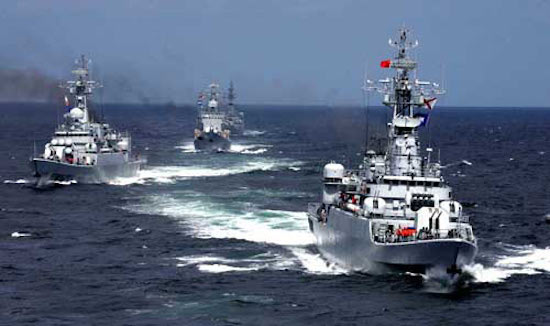
Some military experts project that within a little more than a decade, China’s People’s Liberation Army Navy may have more warships than Washington under its command. Beijing’s military buildup is part of its strategy to dominate many disputed territories in the South China Sea – and push America back.
Retaining U.S. global military dominance is at the heart of President Donald Trump’s plan to up Pentagon spending by $54 billion, or roughly 9 percent. That alone, however, will not be enough to maintain Washington’s regional military edge. China’s own defense budget has increased by double digits almost every year for the last two decades – although it slowed slightly last year. More importantly, Beijing is also adopting a range of tactics to which Washington lacks a truly effective response.
While Washington’s approach in Asia has always been focused on its ability to move aircraft carriers through China’s backyard, Beijing has been doing everything it can to tilt the strategic balance against its possible foes. It’s a strategy that includes new weapons systems, considerable conventional naval expansion but also a host of other tactics including building naval bases, floating power stations and artificial islands.
Some current and former U.S. military officials believe it is a question of when, rather than if, a regional conflict takes place. What seems equally plausible is a decades-long – and perhaps largely bloodless – confrontation remaining just below the threshold of anything that might trigger actual war.
That may well be China’s plan.
It’s a game that Beijing has played in increasing earnest since 1995, when the Chinese military fired several missiles and conducted military maneuvers around Taiwan, which Beijing sees as a breakaway province. U.S. President Bill Clinton responded by sending two aircraft carriers to patrol the waters between Taiwan and mainland China, a move that Beijing’s military could do little to stop without sparking a war it knew it would not win.
Since then, China has focused on gaining the ability to keep U.S. forces – particularly aircraft carriers – out of its immediate neighborhood. Many analysts believe it now possesses enough weapons technology – submarines, missiles and strike aircraft in particular – that U.S. planners would be reluctant to risk their carriers that close to China’s coast again.
China is believed to have thousands of ballistic missiles aimed at the island, as well as naval weaponry to destroy nearby warships. Some experts believe Beijing might try to regain control of the island sometime in the next two decades.
Beijing’s next immediate goal appears to be expanding its military capability much further out – to a number of potentially energy-rich atolls and islands claimed by the Philippines, Vietnam and Malaysia.
Beijing’s most grandiose claims in the South China Sea were rejected last year by the U.N.’s top international maritime court. China has, however, continued to build and expand, particularly around the disputed Scarborough Shoal. The Chinese military landed on the islands – also claimed by the Philippines – in 2012 and have since built up their presence there.
From these disputed bases, Beijing’s military claims a range of air and sea areas under its jurisdiction, demanding foreign aircraft and ships register with them. American, Australian and other military forces make a point of flouting these rules – which have little international legitimacy – with relative impunity.
No one has a strategy to stop the Chinese. At his confirmation hearings, new U.S. Secretary of State Rex Tillerson raised eyebrows by suggesting U.S. forces might somehow deny China access to the disputed islands. That would almost certainly start a war, however, and the idea has not been mentioned since.
In many ways, what has happened in the South China Sea resembles a more gradual version of what Vladimir Putin’s Russia achieved in Crimea during its 2014 takeover – using armed men without uniform to change the reality on the ground before Ukraine or its allies could react.
In Ukraine, Russia later proved itself willing to use more overt – although still officially denied – military force to seize control of some Russian-speaking areas in the east of the country. The question in the South China Sea is whether Beijing might consider something similar – and what might happen if it does.
China has also become increasingly focused on acquiring the kind of high-level, high-value military assets that the United States has used against it in the past. China’s first aircraft carrier – a former Soviet vessel rebuilt – is becoming ever more effective, although it remains primarily used for training. In December, it conducted what appeared to be its first long-range patrol outside China’s coastal waters. China is also constructing its first domestically built carrier and reportedly working on another.
Such ships are important to Beijing’s international image – witness the attention Russia got through sending its only carrier to conduct airstrikes in Syria late last year. So are the ballistic missile submarines that – like Russia – Beijing is increasingly building, a stark reminder to any potential enemies of the cataclysmic consequences of outright war.
According to some estimates, over the next 10 to15 years, China could build its fleet to a total of 500, including up to four aircraft carriers and 100 submarines as well as smaller but sophisticated corvettes, patrol boats and other combat craft. That compares to Trump’s planned expansion of the U.S. Navy to some 350 vessels, including a larger proportion of more powerful vessels, but spread across the entire world.
In sailing through the disputed waters of the South China Sea, the Carl Vinson has once again shown America’s military might. In the event of an actual war, however, it is far from clear how long such a massive vessel would survive before being sunk.
In any case, the Carl Vinson will be gone next week – although other forces will remain – and the Chinese will still be building. (Reuters)