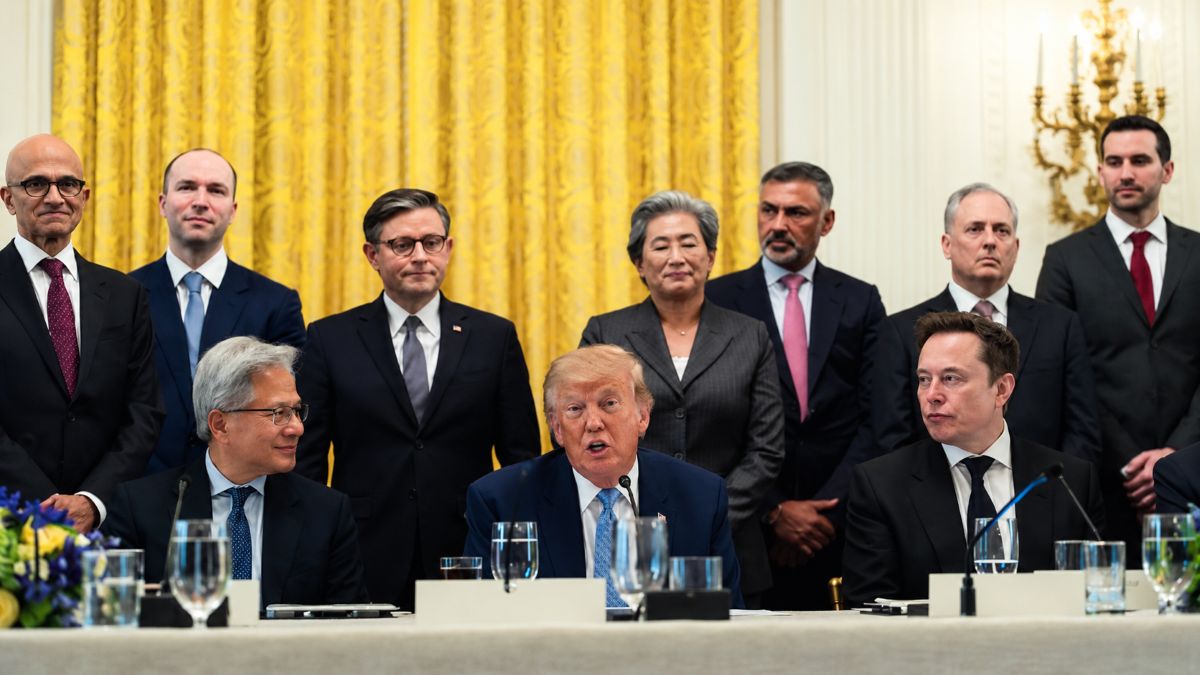

WASHINGTON: US President Donald Trump and six technology executives signed a White House AI accord on Tuesday committing their companies to safety controls and external evaluations, but without enforcement penalties.
Signatories included Google’s Sundar Pichai, Anthropic’s Dario Amodei, Meta’s Mark Zuckerberg, OpenAI’s Greg Brockman, Elon Musk and Nvidia’s Jensen Huang.
Under the agreement, companies must monitor model capabilities during training and deployment for cybersecurity, biosecurity and chemical risks. They must also establish internal safety teams and independent board committees.
Each company must partner with an independent external auditor or evaluator. However, the agreement names no auditors and sets no implementation deadline. It requires neither publication of findings nor penalties for breaches.
Read: UN AI Safety Warnings Dominate Security Council Session
Asked about enforcement, Trump described the accord as “morally binding”. He argued that companies would police one another because their businesses were at stake.
Meanwhile, Vice President JD Vance urged developers to take responsibility for risks rather than seek a new government regulatory regime.
House Speaker Mike Johnson described the document as industry principles and indicated that Congress would continue deliberating.
Read: Maven AI Contribution to Strike That Killed 123 Children in Minab, Bloomberg
Senator Mark Warner criticised the reliance on self-regulation. He and Senators Brian Schatz and Andy Kim proposed legislation on September 24 to establish an AI Safety Board within the Commerce Department. Their bill would require access to frontier models before release, mandate incident reporting and impose fines for violations.
Although the accord allows for possible legislation later, it commits companies only to regular meetings to establish standards.
Separately, Trump signed an executive order directing federal agencies to replace “artificial intelligence” with “Super Intelligence”. He announced plans to appoint a sector adviser and was considering an oversight committee of about 10 people.