

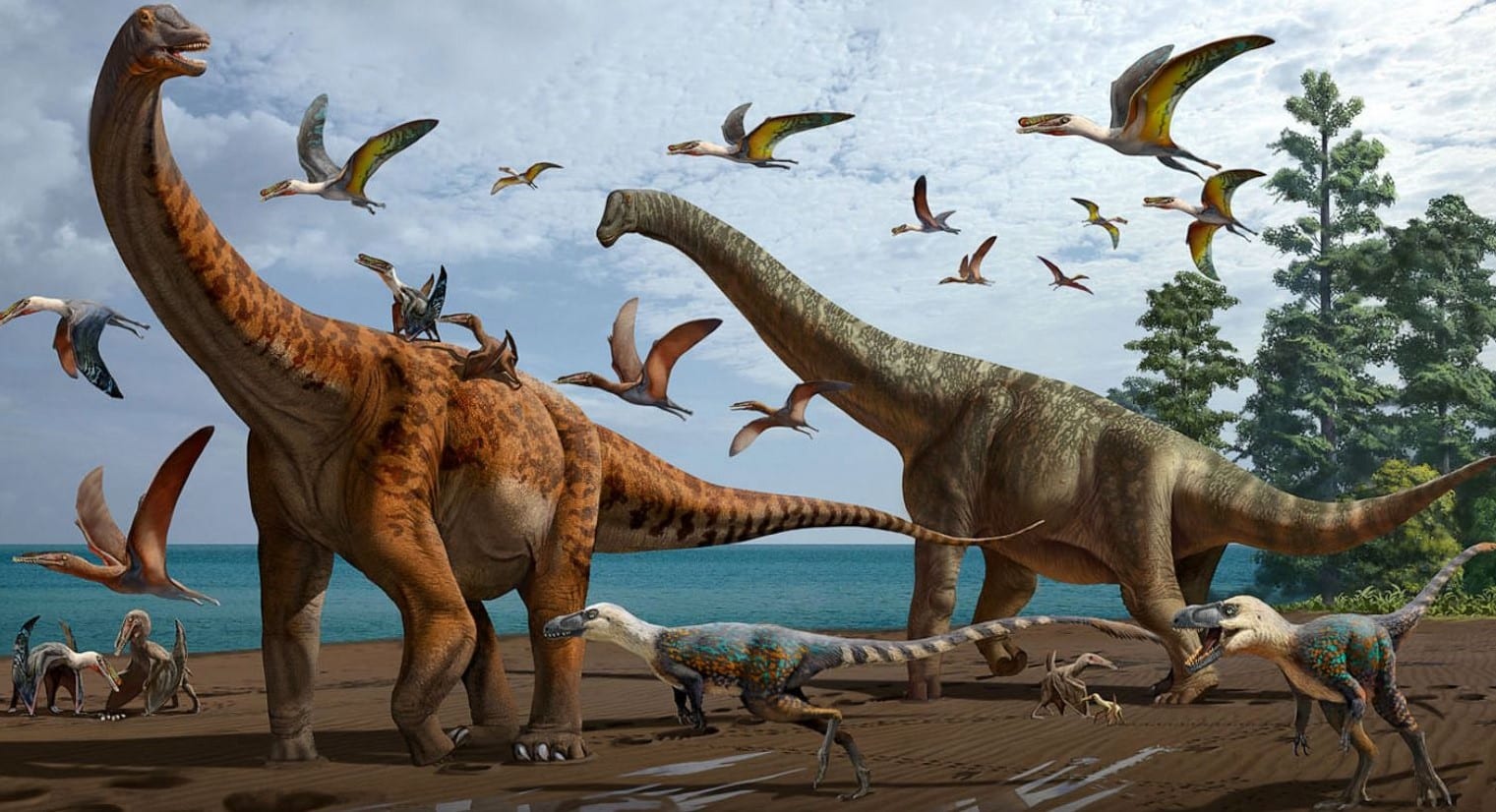

The age of dinosaurs ended in cataclysm one spring day 66 million years ago when an asteroid 7.5 miles (12 km) wide hit Mexico’s Yucatan peninsula, triggering the extinction of those remarkable beasts and about three-quarters of Earth’s species.
But were the dinosaurs already on the way out, with diversification faltering and rates of evolution sputtering, as some scientists have proposed? The answer is a definite “no,” according to a new study that modelled food chains and ecological habitats in North America, the part of the world best represented in the fossil record from that time.
The researchers looked at 18 million years before the asteroid impact that ended the Cretaceous Period and the 4 million years afterwards at the outset of the Paleogene Period when mammals asserted their dominance following the demise of the dinosaurs – aside from their bird lineage.
Based on more than 1,600 fossils, the researchers reconstructed the food chains and habitat preferences of land and freshwater vertebrates. These included the likes of giant meat-eater T. rex, three-horned Triceratops, tank-like Ankylosaurus, crocs, turtles, frogs, fish and the various smallish mammals that lived under the feet of the dinosaurs.
Dinosaurs were entrenched in stable ecological niches for which they were well adapted, the researchers found.
“In other words, the dinosaurs were struck down in their prime,” said ecologist Jorge García-Girón of the University of Oulu in Finland and University of León in Spain, lead author of the research published in the journal Science Advances.
But mammals had begun laying the groundwork for their later ascent, diversifying their ecological niches and evolving more varied diets, behaviours and climate tolerances, García-Girón added.
Dinosaurs continued to evolve and adapt during the twilight of their reign, with new species appearing and old ones disappearing, the study found. Some of the major plant-eaters like the horned and duckbilled dinosaurs were being replaced by a greater variety of medium-sized herbivores.
Some previous research has suggested that dinosaur biodiversity declined well before the asteroid impact, based on the fossil record of various dinosaur families.
“There has been this nagging thought that dinosaurs may have been on their way out anyway, amid a long-term decline, when the asteroid put them out of their misery,” said University of Edinburgh palaeontologist and study co-author Steve Brusatte. “We can now say with conviction: dinosaurs were going strong, with stable ecosystems, right until the asteroid suddenly killed them off.”
The fact that the dinosaurs were so well adapted to their climate and environment may have been their undoing.
“When the asteroid hit, it threw everything into chaos and dinosaurs could not deal with the sudden change to a world they were so accustomed to,” Brusatte said.
“Our study suggests that it was probably the interplay among many other ecological features, including their body size, diets, behaviours and ecospace plasticity that prepared certain smaller animals for greater survivorship after the asteroid impact,” said palaeontologist and study co-author Alfio Alessandro Chiarenza of the University of Vigo in Spain.
Mammals around before the asteroid included a now-extinct rodent-like group called multituberculates, as well as relatives of today’s marsupials called metatherians and relatives of today’s placentals called eutherians.
After the mass extinction, new mammals arose, including many true placentals – the group that gives live birth to well-developed young, encompassing most of today’s mammals from whales to bats and from aardvarks to humans. The post-apocalyptic mammals rapidly expanded in body size and ecological variety.
“Mammals and dinosaurs have the same origin story – they both originated and began to diversify back in the Triassic Period, around 230 million years ago, on the supercontinent of Pangea,” Brusatte said.
“From there, they went their separate ways, with dinosaurs going for grandeur and mammals relegated to small sizes in the shadows,” Brusatte added. “But their fates would be forever intertwined. Mammals were there when the asteroid hit. They made it through. We had ancestors that stared down the asteroid.” (Reuters)



 wide hit Mexico's Yucatan peninsula.)