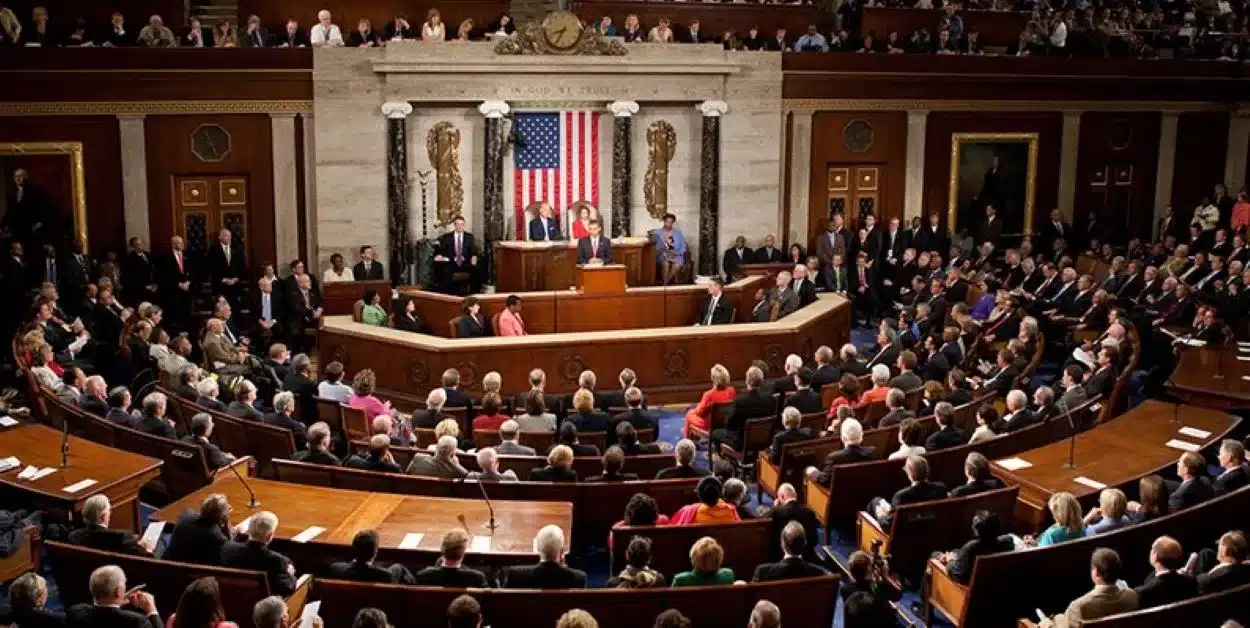

The United States Senate on Thursday advanced a resolution that would prevent President Donald Trump from taking further military action against Venezuela without explicit approval from Congress, marking an uncommon challenge to the Republican leader.
Lawmakers passed the procedural vote by 52 to 47, allowing debate on the war powers resolution to move forward. Five Republican senators joined all Democrats in backing the measure, while one Republican abstained. The outcome reflected a notable shift in the 100-member chamber.
The vote came just days after US forces captured Venezuelan President Nicolas Maduro during a dramatic operation in Caracas. It followed closed-door briefings in which senior Trump administration officials outlined Venezuela policy to members of Congress.
Supporters of the resolution say the move reinforces Congress’s constitutional authority over decisions to deploy US forces. They argue that lawmakers, not the president alone, must approve military engagement abroad.
Despite the procedural win, the measure faces major obstacles. Even if the Senate passes the resolution, it must also clear the Republican-controlled United States House of Representatives. To take effect, it would then need two-thirds majorities in both chambers to override an expected presidential veto.
Republicans had blocked two similar efforts last year as the administration increased pressure on Venezuela, including maritime operations in the Caribbean and Pacific. In November, a similar resolution failed by a narrow 51–49 margin after officials assured lawmakers they had no plans to strike Venezuelan territory.
The US Senate voted to advance a resolution that would bar President Donald Trump from taking further military action against Venezuela without congressional authorization, even as Trump said US oversight of the troubled nation could last years https://t.co/BmqJcqfXb6 pic.twitter.com/57106ggkmM
— Reuters (@Reuters) January 8, 2026Following Maduro’s capture, some Democrats and Republicans accused the administration of misleading Congress. Lawmakers also raised concerns that Trump’s rhetoric could signal broader military ambitions, including potential actions involving Greenland, Colombia, Cuba, or Iran.
Thursday’s vote clears the way for full Senate debate and a final vote next week.
Growing Republican Unease
Republican Senator Rand Paul, a co-sponsor of the resolution, said before the vote that several members of his party were reconsidering their stance. He appeared alongside Democratic Senator Tim Kaine, another co-sponsor, as both serve on the Foreign Relations Committee.
After the vote, Kaine called the outcome a “big victory.” He said Congress must not allow any president to send Americans into war without notice, debate, and a formal vote.
The five Republicans who supported advancing the resolution were Paul, Susan Collins, Josh Hawley, Lisa Murkowski, and Todd Young. Republicans currently hold a 53–47 majority in the Senate.
US Senate Advances Resolution To Limit Trump's Attacks Against Venezuela https://t.co/7pqEylMy3B @DishhaBagchi shares details with @SehgalRahesha pic.twitter.com/42NXz5lDBu
— NDTV (@ndtv) January 8, 2026Trump strongly criticised the dissenting senators, saying they “should never be elected to office again.” Writing on his Truth Social platform, he accused them of undermining the country’s ability to defend itself.
Fears of a Prolonged Conflict
Backers of the resolution acknowledge its uncertain future but say concerns over cost and duration are growing. The US faces large budget deficits, while Trump has called for raising military spending to $1.5 trillion, up from $1 trillion.
Senate Democratic leader Chuck Schumer warned that recent military actions and Trump’s comments suggest a long-term commitment to Venezuela without clear authorisation.
“The president is openly signalling another extended military and financial engagement abroad,” Schumer said. “That raises serious concerns about another endless war.”
Read: Nicolás Maduro Detained at MDC Brooklyn After U.S. Trial Proceedings Begin
Opponents of the resolution argue that Maduro’s capture was a law-enforcement operation rather than a military campaign. Maduro has pleaded not guilty to US charges related to drugs and weapons. Critics also maintain that the president retains authority as commander-in-chief to conduct limited military operations.
Republican Senator Jim Risch, chairman of the Foreign Relations Committee, said the resolution would have no practical effect. He argued it was intended to publicly rebuke the president rather than stop an active conflict.
As the debate heads toward a final Senate vote, the outcome could shape how far Congress is willing to go in reclaiming its war powers amid escalating global tensions.