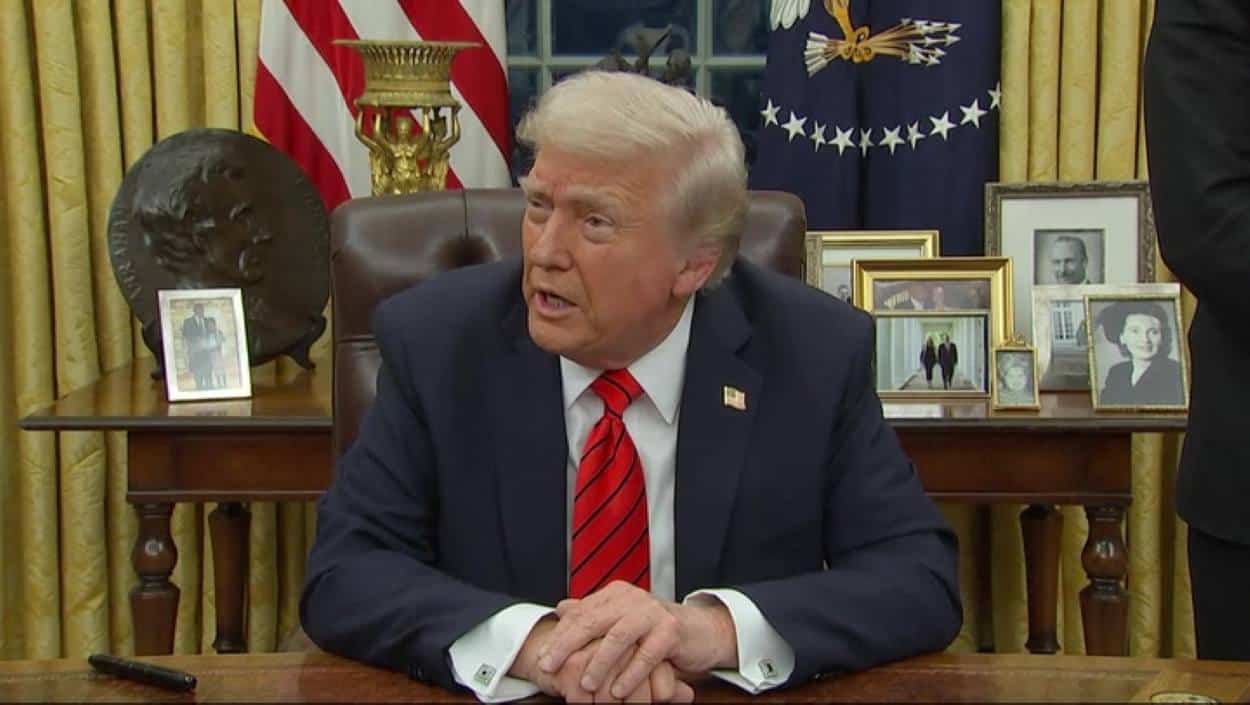

President Donald Trump announced that he would repeal the 2009 EPA climate ruling, formally moving to undo a policy that has shaped US environmental regulation for nearly two decades. The decision means Trump repeals the EPA endangerment finding, a move that significantly alters the federal government’s authority to regulate greenhouse gases.
The endangerment finding, issued in 2009 under the Clean Air Act, determined that greenhouse gases pose a threat to human health and welfare. That determination has served as the legal foundation for federal limits on carbon dioxide, methane, and other emissions from vehicles, power plants, and oil and gas operations.
At the White House, Trump described the repeal as a major policy shift. He was joined by Environmental Protection Agency Administrator Lee Zeldin, who argued that Congress had not clearly authorised such regulation.
Trump Repeals EPA Endangerment
With the repeal, the EPA’s ability to regulate emissions from major pollution sources would be severely restricted. The endangerment finding had been central to federal climate rules since its adoption during the Obama administration.
Zeldin stated that if Congress did not explicitly grant authority to regulate greenhouse gases, the EPA should not exercise that power. He added that any such authority should come directly from lawmakers.
However, critics strongly opposed the move. Environmental organisations described it as a serious setback for US climate policy. They argued that scientific evidence linking greenhouse gases to climate risks remains clear.
And just like that… The Green New SCAM is Dead
President Trump announces a repeal of the EPA's landmark 2009 finding on greenhouse gases' harmful effect on the climate —— KABOOM 💥
“This is the single largest deregulatory action in American history." pic.twitter.com/6QVvtwIOK5
— David 'JoelKatz' Schwartz BP (@Schwartz_Cose) February 12, 2026The repeal has already prompted legal action. The American Lung Association announced plans to challenge the decision in court. Environmental legal experts contend that the Supreme Court has previously recognised the EPA’s authority to regulate greenhouse gases under the Clean Air Act.
If courts uphold the repeal, the EPA would no longer be able to regulate carbon emissions based on the 2009 finding. That would limit the federal government’s climate tools unless Congress passes new legislation.
Read: Trump Expands Power Over Federal Workers in Major Civil Service Overhaul
Supporters of the decision argue that it restores regulatory boundaries. Opponents warn that it could weaken efforts to address rising temperatures, extreme weather, and other climate-related impacts.
The outcome now depends on the courts. Legal challenges are underway, and the broader implications for US climate regulation remain uncertain.