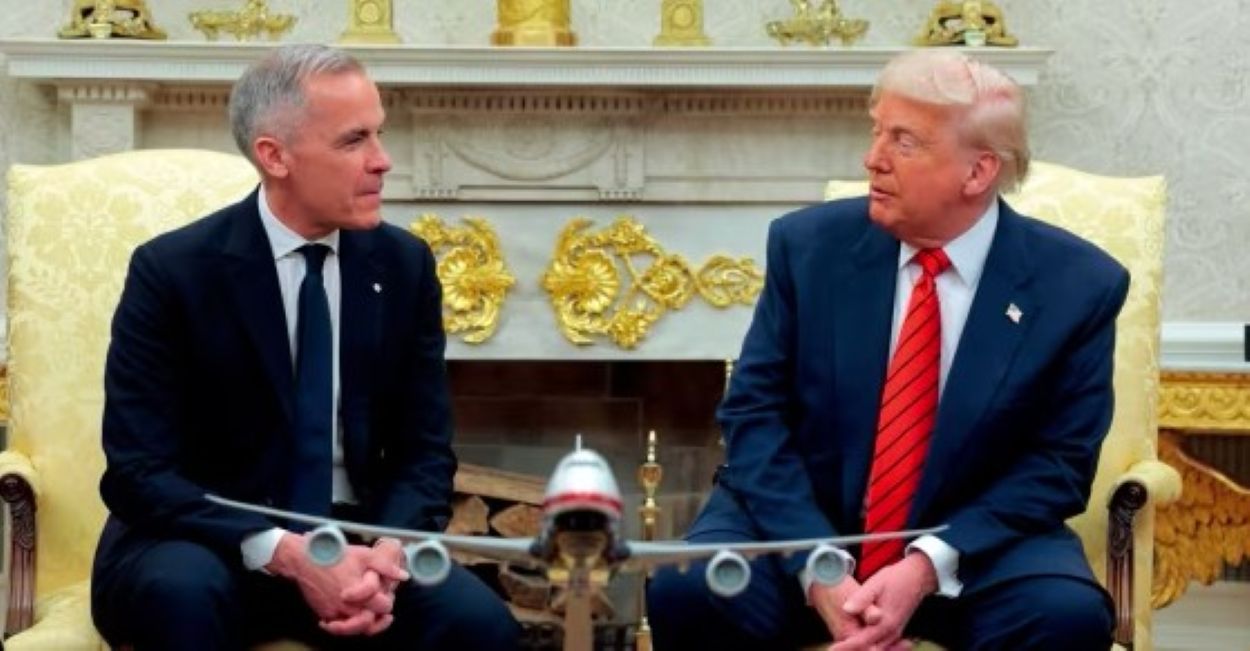

Donald Trump on Saturday threatened to impose a 100% tariff on all Canadian exports if Canada proceeds with a trade agreement with China, sharply escalating tensions between Washington and Ottawa.
In a post on Truth Social, Trump warned that closer trade ties with Beijing would severely harm Canada. He claimed China would dismantle Canadian businesses and weaken the country’s economic and social foundations.
Trump said any agreement with China would trigger immediate tariffs on all Canadian goods entering the United States. He also accused Canada of potentially serving as a transit route for Chinese goods seeking to bypass US trade restrictions.
Responding indirectly, Canadian Prime Minister Mark Carney urged Canadians to support domestic industries. In a video message, he encouraged consumers to focus on what Canada can control and strengthen its internal economy.
Carney recently travelled to China to stabilise strained bilateral ties. Canadian officials later clarified that the visit resolved specific tariff disputes rather than launching negotiations for a full free trade agreement.
Canada’s Trade Minister Dominic LeBlanc said the government had not pursued a comprehensive trade deal with Beijing. He stressed that talks focused on easing existing trade barriers.
The Chinese Embassy in Canada said Beijing remains ready to implement agreements reached by both governments and deepen cooperation within agreed frameworks.
We’re buying Canadian, and we’re building Canadian. pic.twitter.com/JpKhEFKA2P
— Mark Carney (@MarkJCarney) January 24, 2026Tensions have intensified since Carney publicly criticised Trump’s foreign policy, including remarks on Greenland and the decline of a rules-based global order. Speaking at the World Economic Forum in Switzerland, Carney urged middle powers to act collectively to avoid economic coercion.
Trump later dismissed those comments, stating Canada depended on the United States for its prosperity. Carney rejected that claim, saying Canada thrives because of its own economic strength and national identity.
If Trump enacts the threatened tariff, Canadian industries such as autos, metals, and machinery would face immediate pressure. Business groups warned that renewed trade uncertainty could disrupt supply chains and investment.
Despite repeated tariff threats since Trump’s return to office, several measures have stalled or softened during negotiations. Analysts say the latest warning adds uncertainty ahead of talks to renegotiate the US-Canada-Mexico trade agreement, scheduled for July.
The Canadian Chamber of Commerce urged both governments to de-escalate quickly, warning that prolonged uncertainty would hit businesses first.