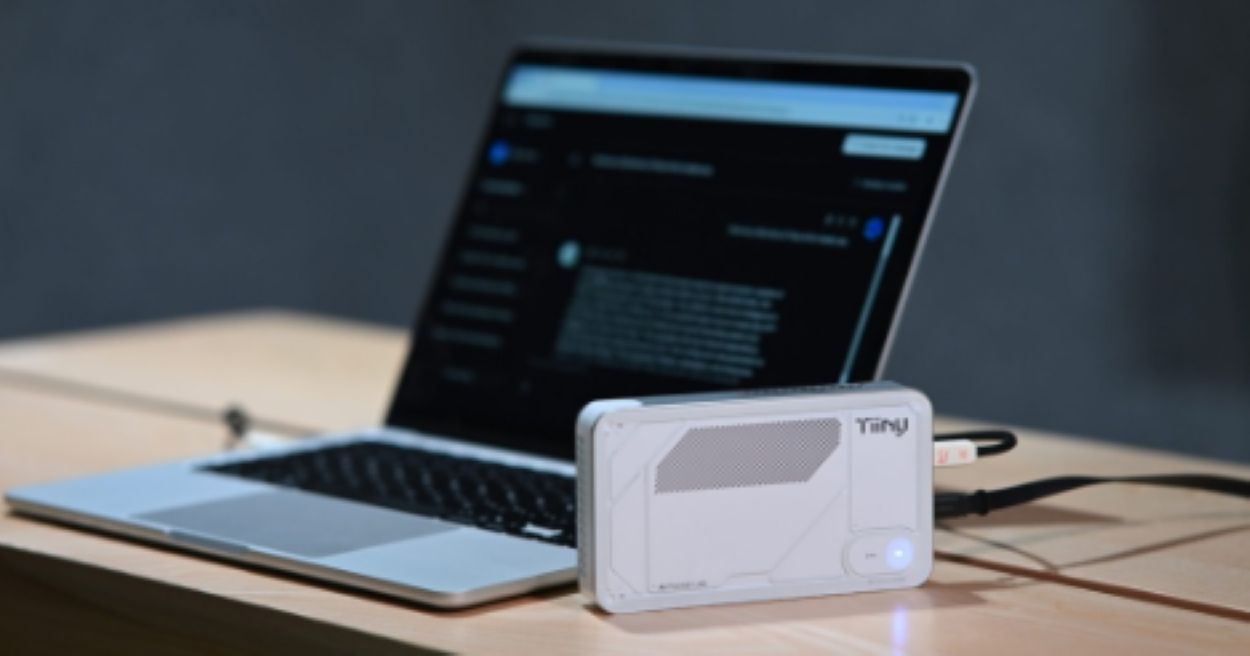

Tiiny AI has introduced a breakthrough in computing with the launch of Pocket Lab, the world’s smallest personal AI supercomputer. The device, roughly the size of a power bank, marks a significant shift. It changes how advanced artificial intelligence can be accessed and used.
Guinness World Records has officially recognised Pocket Lab as the smallest AI supercomputer ever created. This confirms its place as a global first.
Despite its compact form, Pocket Lab delivers performance typically reserved for large and costly systems. The device measures 14.2 × 8 × 2.53 centimetres, weighs just 300 grams, and fits easily into a pocket or small bag.
Pocket Lab can run large language models with up to 120 billion parameters, a capability usually limited to server-grade hardware. It features a powerful ARM v9.2 12-core CPU and supports leading open-source AI models, including GPT-OSS and Llama.
Tiiny AI believes the biggest obstacle in AI adoption is not hardware power but dependence on cloud infrastructure. Samar Bhoj, GTM Director at Tiiny AI, said intelligence should remain with users rather than data centres.
Pocket Lab enables AI models to run locally. This enhances privacy, reduces latency, and enables personalised AI experiences without constant internet access.
The device integrates two proprietary technologies that boost efficiency and performance. TurboSparse improves inference speed, while PowerInfer distributes workloads intelligently between the CPU and the neural processing unit.
While compact AI systems like NVIDIA’s Project Digits and DGX Spark cost between $3,000 and $4,000, Tiiny AI aims to make Pocket Lab far more accessible. The company has positioned the device as a personal AI tool rather than enterprise-only hardware.
Tiiny AI plans to showcase Pocket Lab at CES 2026. The company has not yet announced pricing or a release date. However, expectations are high given the device’s capabilities and form factor.