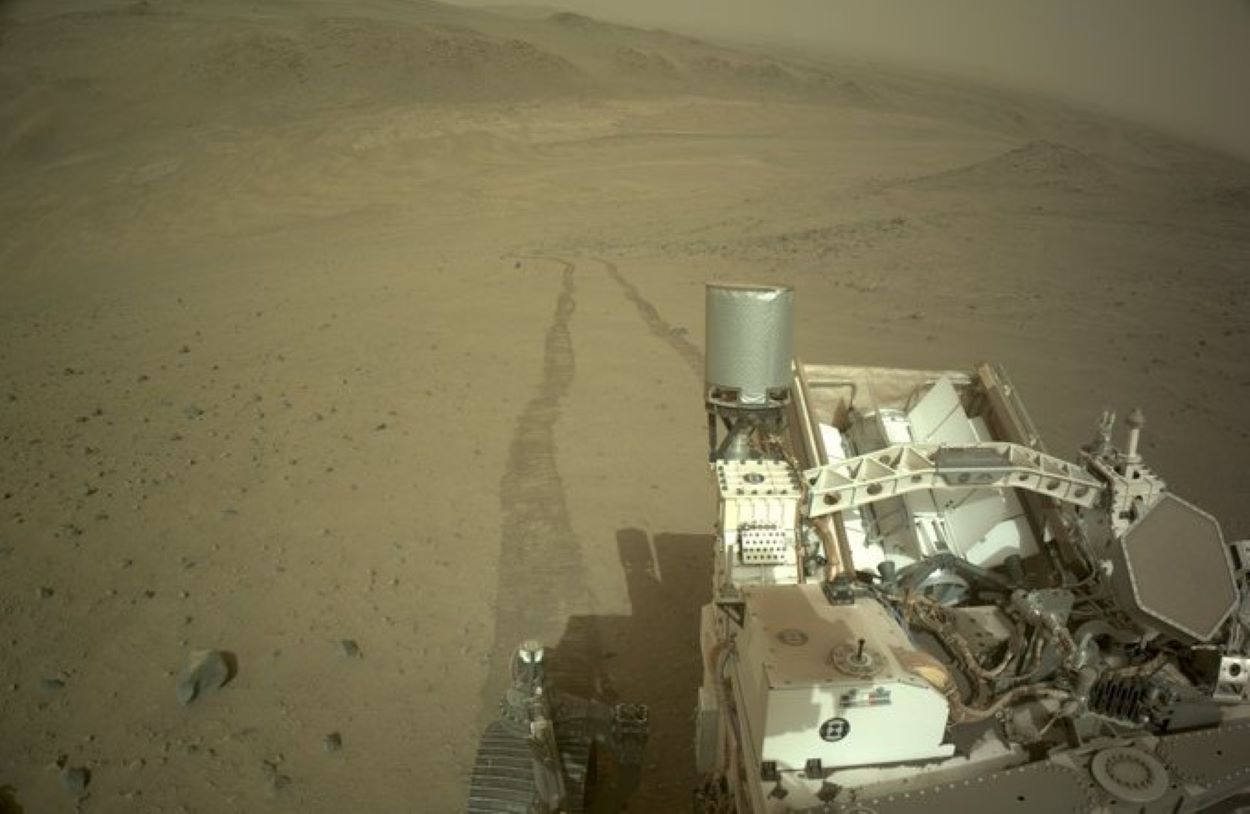

The National Aeronautics and Space Administration (NASA) has marked a major milestone after its Perseverance rover successfully completed the first artificial intelligence-planned drive on another planet.
During the test, Perseverance used an AI model called Claude, developed by Anthropic, to chart a safe 400-metre route across the rocky surface of Jezero Crater. The rover carried out the drive over two Martian days on December 8 and 10, 2025.
Until now, engineers at NASA’s Jet Propulsion Laboratory manually planned rover routes. The vast distance between Earth and Mars, which averages about 140 million miles, creates a communication delay of nearly 20 minutes. That delay prevents real-time driving.
Instead, mission teams traditionally create detailed waypoint paths, often called breadcrumb trails. The rover then follows these paths autonomously between checkpoints.
Perseverance just did something it’s never done before.
On Dec. 8 and 10, 2025, the Mars rover completed drives planned by generative AI. The first-of-its-kind demonstration hints at a future of more efficient exploration and even more science. https://t.co/RbWmJXeVWi pic.twitter.com/ylLPs4tZq6
— NASA JPL (@NASAJPL) January 30, 2026For this experiment, engineers provided Claude with years of Mars mission data. The AI analysed high-resolution orbital images and rover observations to identify hazards such as boulder fields and sand ripples. It then produced a continuous, safe route instead of a series of fixed waypoints.
Tested, Verified, and Executed
Claude also generated the driving commands using the rover’s specialised programming language. Engineers at JPL verified the plan through standard simulations and reviewed more than 500,000 variables before approval.
NASA’s Perseverance Mars rover has completed the first drives on another world that were planned by artificial intelligence. The demonstration hints at a future of more efficient exploration and even more science. https://t.co/15zCnyvpcL pic.twitter.com/24XCUfEkdF
— NASA Mars (@NASAMars) January 31, 2026After one minor adjustment, Perseverance executed the AI-planned route without issues. The rover travelled 689 feet on the first sol and 807 feet on the second, completing the drive exactly as designed.
What This Means for Future Missions
The success shows how AI can reduce planning time and increase rover autonomy on distant worlds. Scientists say similar systems could allow future missions to explore faster and react more effectively to changing terrain.
Read: Why Mars Remains Barren: NASA Rover’s Carbonate Discovery Offers Clues
NASA views the test as a step toward smarter robotic exploration, especially for missions that operate far beyond Earth’s immediate reach.