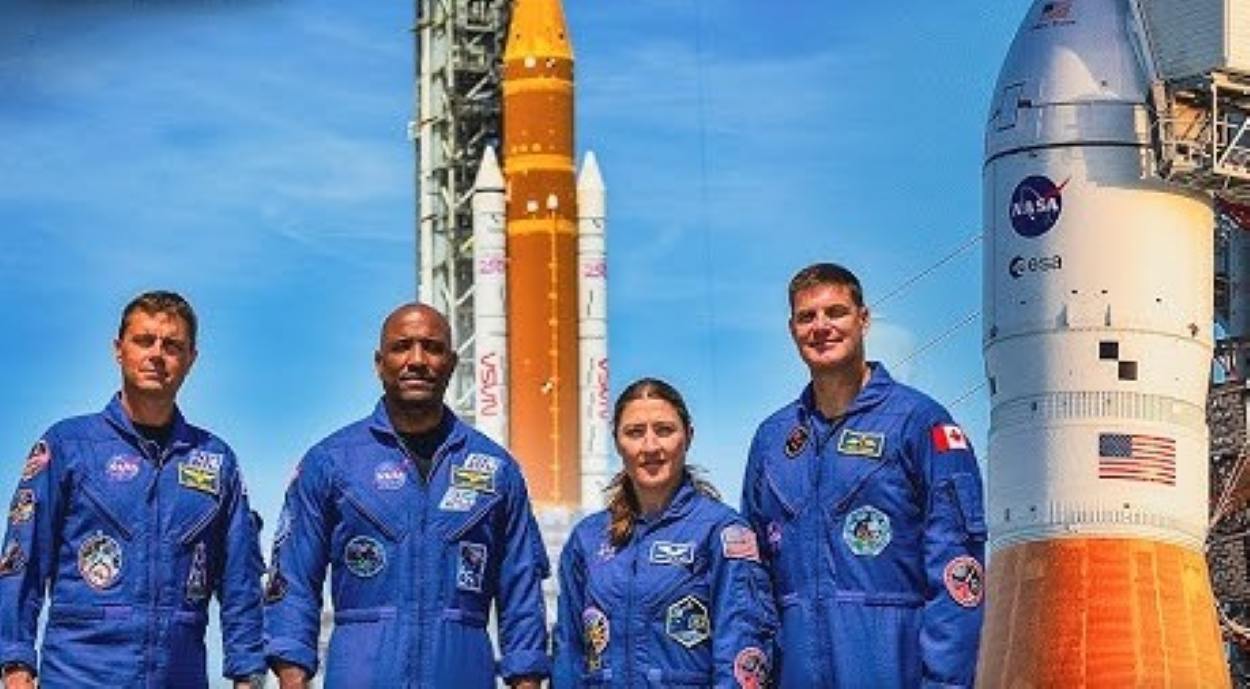

The NASA Artemis II crewed lunar mission has officially launched, marking the first time in over half a century that astronauts are heading toward the moon.
Four astronauts lifted off from NASA’s Kennedy Space Centre in Florida aboard a towering rocket, beginning a nearly 10-day journey around the moon and back.
The mission represents a significant milestone in NASA’s Artemis program, which aims to return humans to the lunar surface later this decade. Thousands gathered at Cape Canaveral to witness the liftoff, highlighting global interest in the historic mission.
The Orion spacecraft successfully separated from the upper stage of the rocket, and the "proximity operations" test is underway. The Artemis II astronauts are manually piloting Orion similarly to how they would if they were docking with another spacecraft. pic.twitter.com/RWW4RSyaoq
— NASA (@NASA) April 2, 2026The crew includes NASA astronauts Reid Wiseman, Victor Glover, and Christina Koch, as well as Canadian Space Agency astronaut Jeremy Hansen.
Together, they will travel farther into space than humans have in decades, pushing the boundaries of modern space exploration. During the first one to two days, the astronauts will remain in high Earth orbit. They will conduct detailed system checks of the Orion spacecraft.
LIVE: Artemis leaders are discussing the successful launch of NASA's Artemis II mission and the next steps for the astronauts headed on their journey around the Moon. https://t.co/U1Bt9FPNc1
— NASA (@NASA) April 2, 2026These tests include evaluating life-support systems, propulsion, navigation, and communication to ensure readiness for deep space travel. Launch director Charlie Blackwell-Thompson described the mission as a symbol of global collaboration and ambition.
“This mission carries the hopes and dreams of a new generation,” she said during the launch.
Read: NASA Artemis II Astronauts Enter Final Launch Preparations
Shortly after liftoff, Commander Reid Wiseman confirmed the spacecraft’s direction, noting a clear view of the moon as the crew began their journey. Artemis II is a crucial step toward future crewed landings on the moon. It also comes amid growing global competition in space exploration.
NASA aims to use this mission to validate systems that will support long-term human presence on the lunar surface.