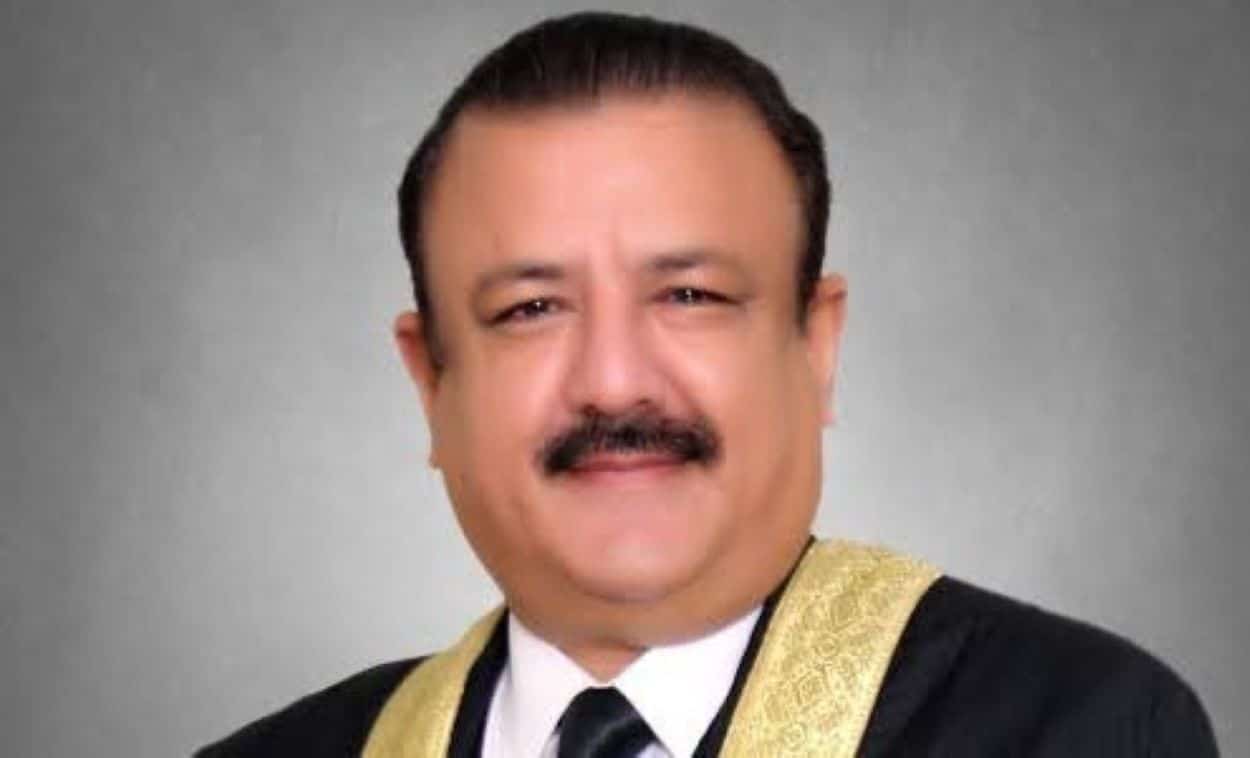

The Islamabad High Court on Thursday ordered the removal of Justice Tariq Mehmood Jahangiri, ruling that he lacked a valid law degree at the time of his judicial appointment.
A two-member bench led by Chief Justice Sardar Muhammad Sarfraz Dogar, with Justice Azam Khan, held that Justice Jahangiri did not meet the constitutional eligibility requirements. The court declared his appointment unlawful and directed the Ministry of Law and Justice to denotify him immediately.
The ruling stems from a dispute over Justice Jahangiri’s LLB degree, which the University of Karachi cancelled following an inquiry. The university’s syndicate upheld the findings of its Unfair Means Committee in a meeting held on August 31, 2024. A formal notification dated September 25 confirmed the cancellation.
Justice Jahangiri did not appear in person during the hearing. His counsel, including Advocate Akram Sheikh and Barrister Salahuddin, represented him. Barrister Salahuddin argued that multiple petitions related to the matter remained pending and requested that the court hear them first. He also sought additional time to submit replies.
Advocate Sheikh alleged procedural violations and raised concerns about judicial bias. He told the court that Justice Jahangiri had initiated proceedings against the chief justice and other transferred judges. He questioned whether the bench could hear the case impartially, noting that related matters remained pending before constitutional forums.
Read: Justice Tariq Jahangiri Moves FCC Against IHC Degree Petition Ruling
Opposing counsel Advocate Mian Dawood countered that the Supreme Court, under writs of quo warranto, holds the authority to examine every document linked to a judicial appointment. He alleged that Justice Jahangiri took an invalid oath and failed to provide authentic academic records. He urged the court to order the production of the original LLB mark sheets.
During the proceedings, Karachi University Registrar Imran Siddiqui appeared and submitted original academic records. He confirmed that the university had cancelled the degree after concluding that Justice Jahangiri used irregular enrolment details to bypass a disciplinary ban.
The registrar told the court that the Unfair Means Committee had barred Justice Jahangiri for three years after finding him guilty of cheating and threatening an examiner. He said the judge later appeared in LLB examinations under different names and enrolment numbers, which the university could not verify.
Justice Dogar asked whether the degree cancellation stood as a final decision. The registrar confirmed it did. Barrister Salahuddin responded that the Sindh High Court had suspended the university’s declaration and argued that the case involved procedural irregularities rather than a fake degree.
The registrar also informed the court that Islamia Law College denied any record of Justice Jahangiri as a student. He added that the university’s syndicate revoked the degree upon verification of these findings.
Islamabad Bar Council lawyer Raja Aleem Abbasi reminded the court that the Sindh High Court had suspended the cancellation order, a point noted during the hearing.
Despite these arguments, the Islamabad High Court ruled that Justice Jahangiri did not hold a valid LLB degree at the time of appointment. The bench concluded that the defect struck at the root of his eligibility and ordered his immediate removal.