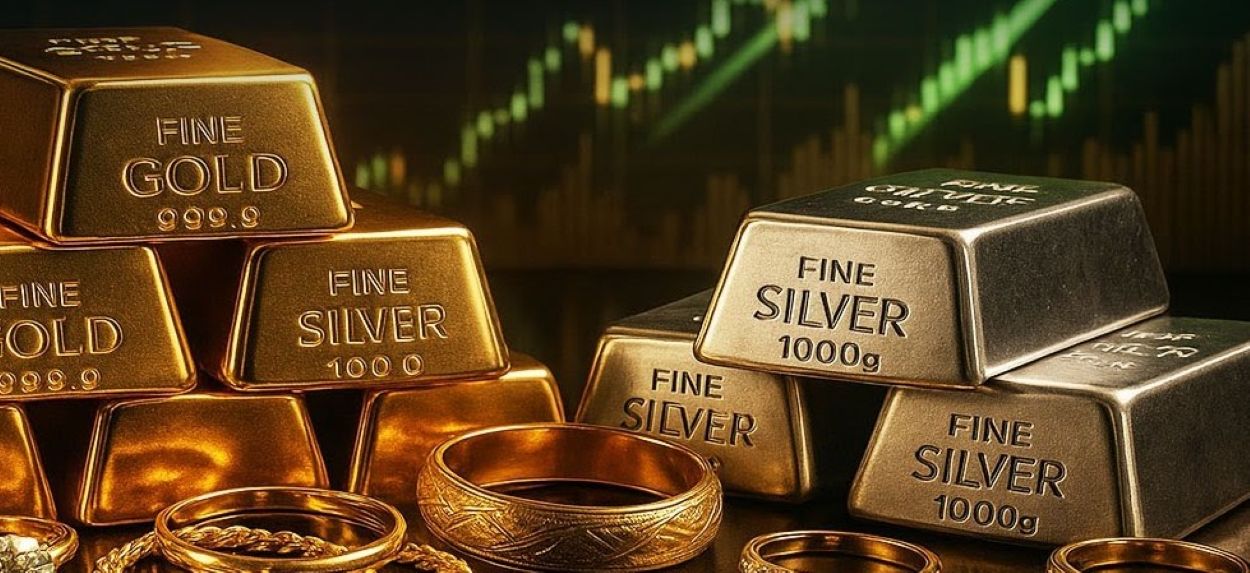

Gold and silver surged to record highs on Monday as global equity markets weakened amid renewed trade-war fears sparked by Donald Trump. Investors moved into safe-haven assets after the US president threatened several European countries with new tariffs over their opposition to Washington’s ambitions for Greenland.
Trump has heightened geopolitical tensions this month by insisting the United States should take control of Greenland, citing national security concerns. Over the weekend, he escalated the dispute after talks failed to resolve what he described as a fundamental disagreement with European partners over the Danish autonomous territory.
On Saturday, Trump announced plans to impose tariffs on eight countries. He said the United States would levy 10 per cent duties from February 1 on Denmark, Norway, Sweden, France, Germany, the United Kingdom, the Netherlands, and Finland. The tariffs would rise to 25 per cent from June 1 if the countries did not agree to his demands.
Gold and silver jump to record highs on Greenland tariff threats https://t.co/1Peu3ojWlK via @business
— Yahoo Finance (@YahooFinance) January 19, 2026The announcement drew an immediate response from the affected nations. In a joint statement, they warned that tariff threats undermine transatlantic relations and risk triggering a dangerous downward spiral. The dispute also cast doubt on a trade agreement signed last year between the United States and the European Union. German Foreign Minister Johann Wadephul said he did not believe the deal could proceed under the current conditions.
Officials close to Emmanuel Macron said France may urge the EU to activate its rarely used anti-coercion instrument if the tariff threat becomes policy. The mechanism allows the bloc to curb imports of goods and services and restrict market access across its 27 member states, which together represent a market of around 450 million people.
According to Bloomberg, EU member states are also discussing retaliatory tariffs on up to €93 billion worth of US goods. The growing prospect of a trade war between major economic powers unsettled markets and accelerated the shift toward defensive assets.
Gold, Silver hit fresh record highs on MCX | Investment strategy in gold & silver
Watch: https://t.co/ipF094hZ5A | #MCX #PreciousMetals #BullRun #GoldPrice #SilverPrice #IndianMarkets @BakayaAabh80607 | @sharad_avasthi pic.twitter.com/1y7rhqaFgW
— Business Today (@business_today) January 14, 2026Gold, traditionally viewed as a hedge during periods of uncertainty, climbed to a record high of $4,690.59. Silver also surged, touching $94.12. The gains extended the momentum that began after Trump’s recent threats toward Iran and the United States’ role in the removal of Venezuela’s former president.
Equity markets across Asia mostly retreated. Stocks fell in Tokyo, Hong Kong, Shanghai, Sydney, Singapore, and Wellington. Markets in Seoul and Taipei posted modest gains. European and US futures also moved lower, reflecting cautious investor sentiment.
Currency markets mirrored the risk-off mood. The dollar weakened against major peers, while the euro, sterling, and yen strengthened.
Charu Chanana, chief investment strategist at Saxo Markets, said the key issue for markets is whether the rhetoric turns into policy. She noted that the timing and decision-making process in Europe will matter as much as the headlines, particularly around whether the EU formally pursues countermeasures.
She added that even if tariffs are eventually scaled back, the longer-term risk lies in rising fragmentation. More politicised trade, conditional supply chains, and higher policy uncertainty could weigh on companies and investors for years.
Elsewhere, markets showed little reaction to data indicating that China’s economy grew 5 per cent last year, in line with official targets. However, growth slowed sharply in the final quarter, limiting optimism.
Investors in Seoul and Taipei also shrugged off warnings from US Commerce Secretary Howard Lutnick, who said chipmakers from South Korea and Taiwan could face tariffs of up to 100 per cent if they fail to expand manufacturing in the United States.