

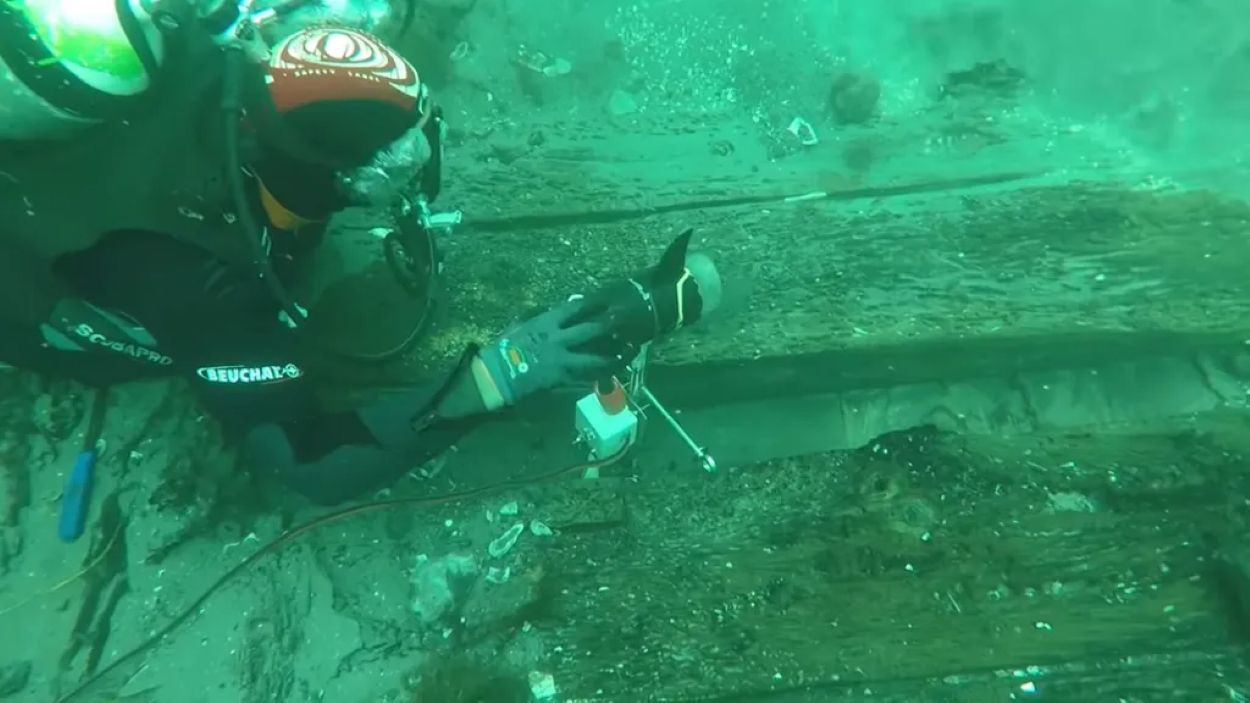

Maritime archaeologists say a Danish warship wreck discovered in Copenhagen Harbour marks a major historical find tied to the Battle of Copenhagen. Denmark’s Viking Ship Museum announced that researchers found the Danish flagship Dannebroge about 50 feet below the surface in near-zero visibility, buried in thick sediment.
The discovery came exactly 225 years after the Battle of Copenhagen on April 2, 1801. Otto Uldum, a maritime archaeologist at the museum, said the team had found Dannebroge and the remains of those who never made it ashore after the battle.
Dannebroge served as the focal point of the Danish-Norwegian defence against Admiral Nelson’s fleet of 39 ships. During the battle, two British ships bombarded the flagship, setting it on fire before it exploded.
Una nave da guerra danese affondata dalla flotta britannica di Nelson è stata ritrovata dopo 225 anni.
Individuato a 15 metri di profondità il relitto della nave da guerra Dannebroge, affondata dall'ammiraglio Nelson oltre due secoli fa. Archeologi in una corsa contro il tempo… pic.twitter.com/cJa67L6lJ7
— LaPresse (@LaPresse_news) April 2, 2026Historical records show that 56 crew members died, more than 40 suffered wounds, and 19 sailors were never found. Archaeologists now believe a human lower jawbone recovered at the site may belong to one of those missing crew members.
Archaeologists also recovered a wide range of artefacts from the wreck area. The finds include two cannons, shoes, clothing fragments, uniform insignia, clay pipes, bottles, and ceramics.
Researchers said the seabed around the wreck is also covered with cannonballs and bar shot, offering more evidence of the violence of the battle. These objects could help historians better understand both the flagship’s final moments and the lives of the sailors on board.
The excavation now faces time pressure because construction linked to Lynetteholm could soon cover the site. Lynetteholm is a controversial 271-acre artificial peninsula designed to protect Copenhagen from rising sea levels.
That means archaeologists may have only a limited window to document the wreck, recover artefacts, and preserve evidence before construction changes the seabed.



