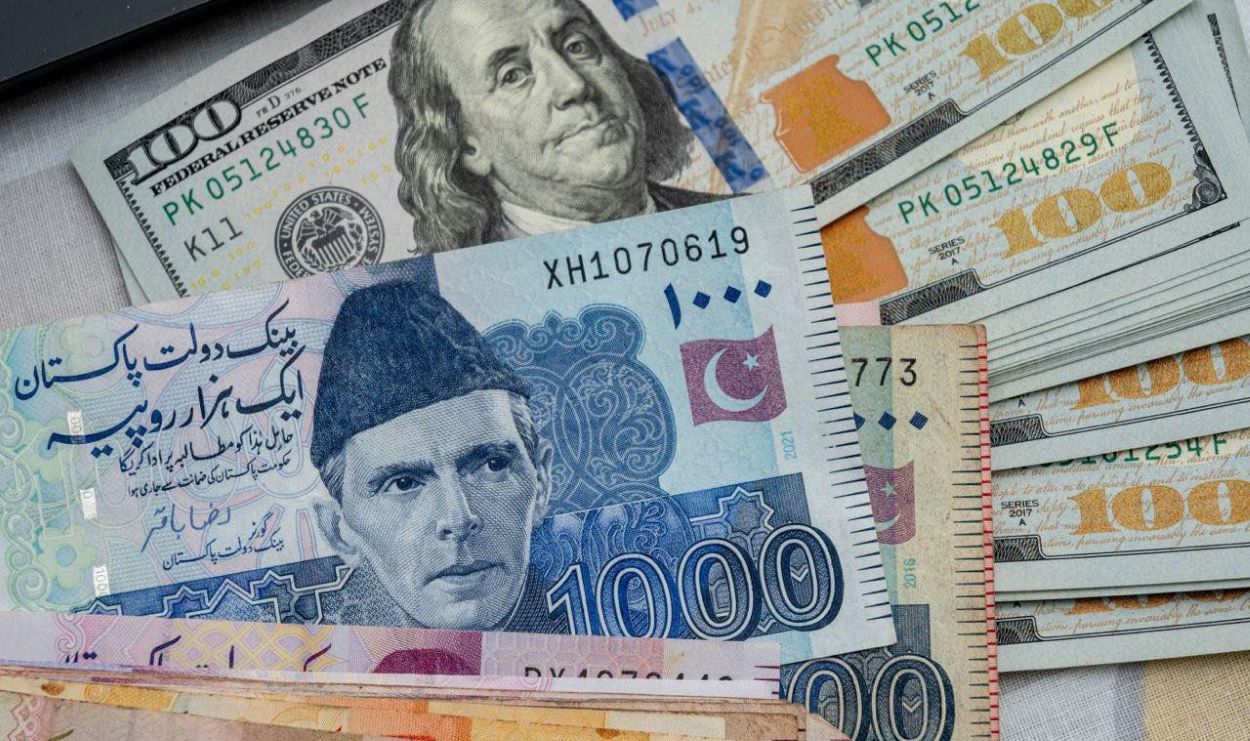

The USD to PKR exchange rate today was fixed at 279.5515 by the State Bank of Pakistan (SBP), marking a slight 2 paisa gain for the rupee and its strongest level of 2026 so far.
The modest retreat keeps the dollar within the 279–282 trading range that has prevailed since October. One-week forward contracts were quoted at 279.87, reflecting a minimal carrying cost.
Market participants reported that exporters continued selling above 279.90, while petroleum importers accumulated dollars on dips below 279.50. A senior treasury official noted that liquidity remains ample and that price movements are largely driven by technical flows rather than new economic catalysts.
Beyond the dollar, several major currencies showed marginal adjustments:
- GBP/PKR: Sterling rose to 377.93. One-year forwards imply 3.7% annualised rupee depreciation.
- SAR/PKR: The Saudi Riyal stood at 74.54, with 12-month forwards indicating 3.0% annualised rupee softness.
- AED/PKR: The UAE Dirham edged up to 76.11, supported by steady remittance inflows.
- QAR/PKR: The Qatari Riyal traded at 76.48, aligned with other Gulf-pegged currencies.
- KWD/PKR: The Kuwaiti Dinar was quoted at 915.66, with slightly wider forward spreads due to thinner market depth.
Commodity-linked currencies also moved modestly. The Australian dollar strengthened to 197.89 as iron ore prices stabilised, while the Canadian dollar firmed to 204.84 alongside steady crude oil prices.
Read: PSX KSE-100 Index Drops 3.16% as US-Iran Tensions Weigh on Market
Among other majors, the euro opened at 330.44, while the Japanese yen remained the most affordable major at 1.81 per unit. Forward premiums across G-10 currencies remained compressed, suggesting limited short-term volatility.
Market Context and Outlook
Pakistan’s foreign exchange reserves have climbed to $21.26 billion, providing support to the rupee. Meanwhile, the real effective exchange rate (REER) eased to 98.2 in November, a level considered competitive under IMF benchmarks.
Currency desks expect the USD/PKR pair to remain within the 278–282 range through the first quarter of 2026, barring a sharp spike in oil prices or political disruptions.
The narrow forward premiums, generally between 4–5% annualised, indicate confidence that the central bank can manage external pressures during the winter remittance window. For official rate updates, traders continue to monitor SBP releases and interbank market data.