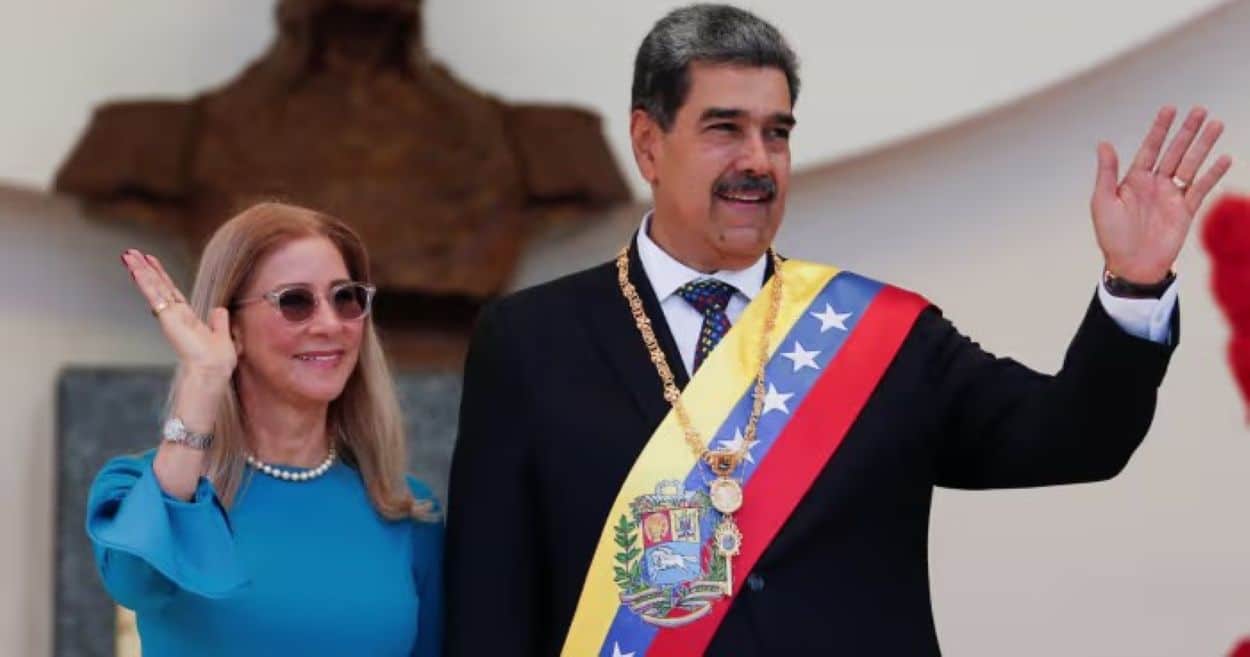

US President Donald Trump said on Saturday that the United States carried out a large-scale strike in Venezuela and captured President Nicolás Maduro, whom authorities allegedly removed from the country.
Trump announced the claim in a post on Truth Social, saying US forces captured Maduro and his wife and flew them out of Venezuela. He said US law enforcement supported the operation and announced a press conference at Mar-a-Lago later in the day.
“This operation was done in conjunction with US law enforcement,” Trump wrote, calling the action a turning point for Venezuela.
There was no immediate confirmation from the Venezuelan government. Officials in Caracas did not issue a public response to Trump’s statement.
US Deputy Secretary of State Christopher Landau echoed Trump’s remarks on X, calling the development “a new dawn for Venezuela” and saying Maduro would face justice for alleged crimes.
US Senator Mike Lee said the military action had concluded, citing a phone call with Secretary of State Marco Rubio. Lee said Rubio expected no further US action in Venezuela following Maduro’s alleged capture.
Venezuela’s opposition coalition, led by María Corina Machado, said it had no official comment on the reports.
Explosions Reported in Caracas
Earlier, Venezuelan authorities accused the United States of attacking civilian and military targets after residents reported explosions and low-flying aircraft over Caracas.
Government officials said at least seven explosions occurred around 2 a.m. local time. Witnesses reported aircraft flying at low altitude across several neighbourhoods. Authorities said strikes hit both civilian and military installations in multiple states.
President Donald Trump has claimed that the US carried out a 'large-scale strike' against Venezuela and captured its leader, President Nicolas Maduro. The abduction of a foreign leader by another state is a serious violation of international law. pic.twitter.com/oSz3sqBCuL
— Al Jazeera English (@AJEnglish) January 3, 2026Smoke rose from a military base hangar in Caracas, while another facility lost power. Residents in nearby areas ran into the streets following the blasts.
“The ground shook. We heard explosions and planes,” said 21-year-old office worker Carmen Hidalgo. “It felt like the air was hitting us.”
Despite the incidents, state television continued regular programming and aired a feature on Venezuelan music and art.
Rising US Pressure on Caracas
The reports came after Trump deployed a US naval task force to the Caribbean and repeatedly raised the possibility of strikes against Venezuela. Earlier in the week, Trump said US forces destroyed a docking area used by what he described as Venezuelan drug boats, though he did not specify the location or the agency involved.
If verified, the operation would mark the first known US land strike on Venezuelan territory since Washington’s 1989 invasion of Panama to remove Manuel Noriega.
Venezuelan President Nicolas Maduro has been captured and flown out of Venezuela, according to US President Donald Trump. The US conducted a "large-scale strike" on the country, he added. pic.twitter.com/z1Sk77TU8V
— DW News (@dwnews) January 3, 2026Maduro had not confirmed or denied the reported earlier strike. On Thursday, he said he remained open to cooperation with Washington after weeks of escalating US military pressure.
Background to the Escalation
On January 2, Maduro accused the United States of seeking control over Venezuela’s oil, gold, rare earth elements, and other mineral resources. He said Washington aimed to dominate the country’s natural wealth.
The Trump administration has accused Maduro of leading a drug trafficking network and said it would intensify operations to curb smuggling. Maduro has denied the allegations and claimed the United States wants to remove him because Venezuela holds the world’s largest proven oil reserves.
In recent weeks, Washington increased pressure by tightening sanctions, informally restricting Venezuelan airspace, and seizing tankers carrying Venezuelan oil. US forces have also carried out multiple maritime strikes in the Caribbean Sea and eastern Pacific since September, targeting vessels Washington links to drug trafficking.