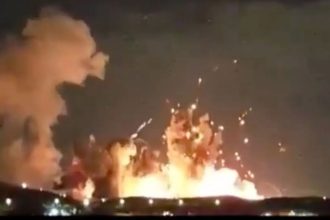
The US-Israel strike on Iran’s Isfahan depot has significantly escalated tensions in the Middle East, with reports of powerful explosions targeting a suspected ammunition facility.
The attack, carried out early Tuesday, reportedly involved 2,000-pound bunker-buster bombs, suggesting a focus on hardened or underground military infrastructure.
U.S. officials cited in reports said the strike focused on a military-linked site in Isfahan, a central Iranian city known for its defence facilities.
The presence of installations such as the Badr airbase underscores the area’s strategic importance. Witnesses reported strong shockwaves and fireballs following the strike, indicating that secondary explosions likely occurred due to stored ammunition.
A video shared by US President Donald Trump on Truth Social showed large explosions and fires lighting up the night sky.
JUST IN: 🇮🇷 Massive explosions in Isfahan, Iran following US-Israeli strikes. pic.twitter.com/UWAS6wJ2iB
— BRICS News (@BRICSinfo) March 31, 2026However, the footage was posted without context, and its authenticity has not been independently verified. Isfahan plays a central role in Iran’s military and nuclear-linked infrastructure.
Reports suggest the city may host underground facilities connected to Iran’s nuclear program, making it a high-value target in any military escalation. Unverified intelligence claims indicate that Iran may have moved a portion of its enriched uranium stockpile to underground locations in the city.
The strike comes as the conflict between the United States, Israel, and Iran enters its second month. Earlier warnings from US leadership indicated that failure in negotiations could lead to broader attacks on Iran’s energy and nuclear infrastructure.
Read: China Seen as Potential Guarantor in Iran-US Talks Amid Pakistan Outreach
The Strait of Hormuz, a key global shipping route, is facing near-closure amid the conflict. This has raised concerns about disruptions to oil, gas, and other essential supplies worldwide. Regional countries, including Saudi Arabia, Kuwait, and the UAE, have reported intercepting drones and missiles, highlighting the widening scope of the conflict. The situation continues to spill over into neighbouring countries.
In one reported incident, attackers struck a Kuwaiti crude carrier near Dubai, raising fears of environmental damage despite no reported injuries. At the same time, regional powers such as Pakistan, Saudi Arabia, Egypt, and Turkey are engaging in diplomatic efforts to de-escalate the crisis.