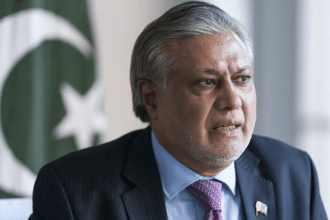
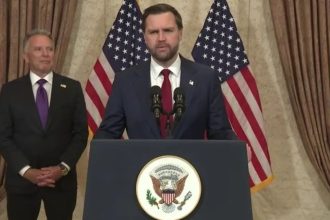
The US-Iran talks ended without a deal after 21 hours of negotiations in Islamabad, dealing a blow to efforts to stabilise a fragile two-week ceasefire and reduce tensions across the region. U.S. Vice President JD Vance said the American delegation left Pakistan without an agreement after Iran refused to accept Washington’s terms.
Speaking after the talks, Vance said the United States had made its red lines clear, especially on Iran’s nuclear programme. He said Washington wanted an affirmative commitment that Iran would not seek a nuclear weapon or the tools needed to quickly build one. AP also reported that Vance described the negotiations as good-faith talks that failed to produce a peace agreement.
US-Iran Talks End Without Deal in Islamabad
The Islamabad Talks marked the first direct meeting between U.S. and Iranian officials in more than a decade and the highest-level contact since the 1979 Islamic Revolution. AP likewise described the negotiations as a rare face-to-face encounter at a critical moment in the conflict.
Here is the full remarks from Vice President JD Vance, announcing that the U.S.-Iran talks ended without an agreement.
Contributed by @AZ_Intel_. pic.twitter.com/NC9mrk9OYG
— Open Source Intel (@Osint613) April 12, 2026Vance’s delegation included special envoy Steve Witkoff and Jared Kushner, while Iran’s team included Parliament Speaker Mohammad Baqer Qalibaf and Foreign Minister Abbas Araqchi. The failure to secure even a preliminary breakthrough now leaves the next phase of diplomacy uncertain.
Nuclear Demands and Hormuz Dispute Dominated the Talks
Vice President JD Vance gives an update in Pakistan:
"The simple fact is that we need to see an affirmative commitment that they will not seek a nuclear weapon, and they will not seek the tools that would enable them to quickly achieve a nuclear weapon." pic.twitter.com/il4THN5DwV
— The White House (@WhiteHouse) April 12, 2026The central dispute focused on Iran’s nuclear programme, the Strait of Hormuz and wider ceasefire demands. Vance emphasised nuclear restrictions as Washington’s core objective, while Iranian state-linked media blamed what it described as excessive U.S. demands for blocking an agreement.
AP reported that the two sides also remained divided over missile issues, regional militant groups and control of the Strait of Hormuz, a chokepoint for global energy supplies. That broad agenda made the talks more consequential, but also harder to conclude successfully.
Strait of Hormuz remains a Critical Flashpoint
The Strait of Hormuz is a central issue in the ceasefire talks. It says the U.S. military began setting conditions to clear the waterway, while Iranian media denied that U.S. warships had transited the strait.
.@VP in Islamabad, Pakistan: "We’ve had a number of substantive discussions with the Iranians. That’s the good news. The bad news is that we have not reached an agreement — and I think that’s bad news for Iran much more than it's bad news for the United States of America." pic.twitter.com/RLIQ30btO5
— Rapid Response 47 (@RapidResponse47) April 12, 2026That dispute matters far beyond the battlefield. AP noted that the conflict has disrupted oil markets and intensified international concern because the strait handles a major share of global energy shipments. Any prolonged standoff there could deepen the economic fallout of the war.
Fragile Ceasefire Faces New Pressure
Although the talks ended without agreement, Iran signalled that technical experts from both sides would continue exchanging documents. AP similarly reported that technical discussions remained alive even after the high-level round broke up.
That leaves diplomacy wounded but not entirely collapsed. Still, the failure of the first round in Islamabad increases pressure on mediators and raises the risk that the two-week ceasefire could weaken if the core disputes over nuclear limits, regional violence and maritime access remain unresolved.