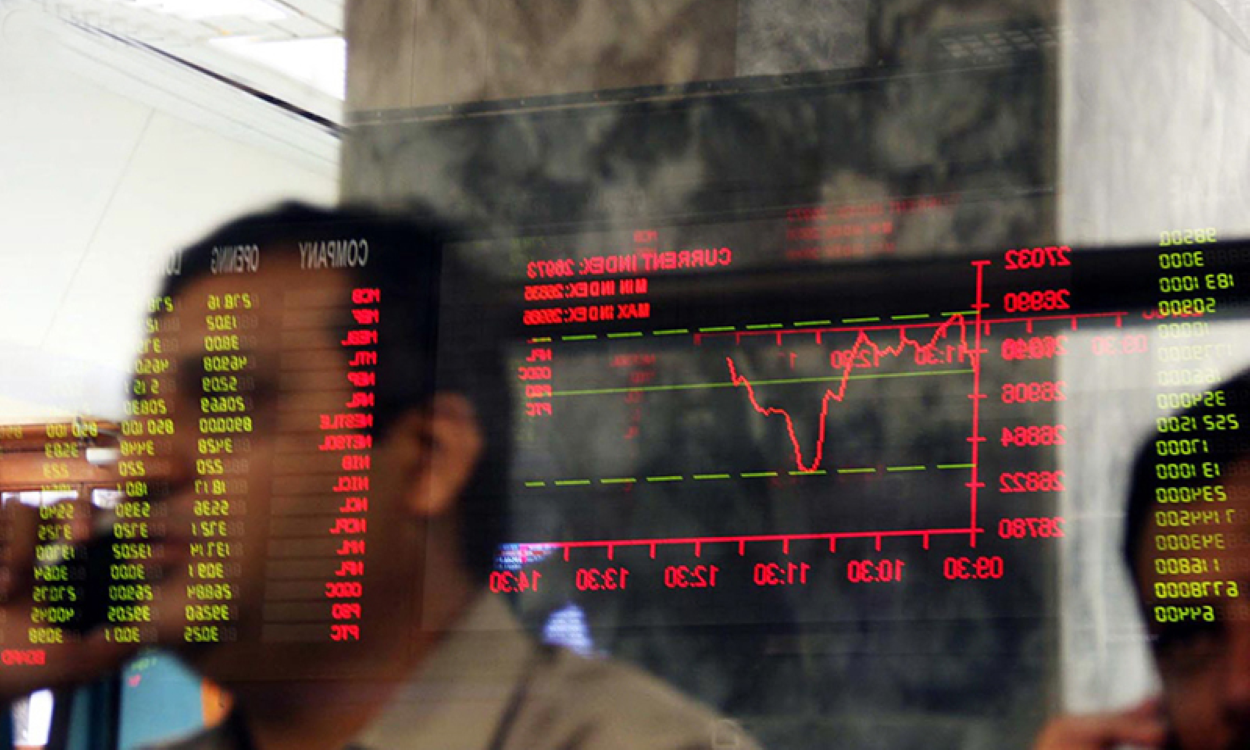

The equity market extended its New Year rally on Monday, with investors responding to asset-allocation flows and easing macroeconomic signals. The benchmark index has gained nearly 7,000 points across the first three trading sessions of 2026.
The Pakistan Stock Exchange benchmark KSE-100 Index climbed to an intraday high of 181,790.12. This marked a gain of 2,755.19 points, or 1.54 per cent, from the previous close of 179,034.93. The index also touched a session low of 179,535.46, still up 500.53 points, before moving higher. The day’s peak set a new all-time intraday record.
Market participants described the start of the year as broadly positive. Independent investment and economic analyst AAH Soomro said investors are deploying significant liquidity to meet annual asset-allocation targets. He cautioned, however, that the pace of gains suggests the market may be moving quickly in the early sessions of the year.
Research houses remain constructive on the near-term outlook. AKD Research said investor sentiment could strengthen further on expectations of foreign portfolio and direct investment inflows. The brokerage added that the KSE-100 Index may extend its upward trajectory toward 263,800 by December 2026, supported by easing monetary conditions, improving external accounts, and continued reform momentum.
Last week, the index advanced 6,634 points, or 3.8 per cent week-on-week, to close at a then-record 179,035. The rally was supported by a softer-than-expected December 2025 Consumer Price Index reading of 5.6 per cent, which reinforced expectations of further monetary easing. On Friday alone, the benchmark gained 2,679.44 points, or 1.52 per cent.
On the macro front, Pakistan’s trade deficit widened 24 per cent year-on-year to $3.7 billion in December 2025, while GDP growth stood at 3.7 per cent year-on-year in the first quarter of FY26. Foreign exchange reserves held by the State Bank of Pakistan rose by $13 million week-on-week to $15.9 billion as of December 26. The rupee appreciated slightly to 280.11 against the US dollar.
The central bank reported net purchases of $6.9 billion from the currency market over the past 12 months. Meanwhile, the Federal Board of Revenue collected Rs6.2 trillion during the first half of FY26, falling short of the target by Rs338 billion.
Authorities also explored a $1 billion liability settlement through a potential UAE investment in the Fauji Group. Separately, the United States signalled renewed interest in partnerships involving locomotive sales and mineral exploration. Officials also outlined plans to issue Pakistan’s first Panda bond in China.
Inflation indicators showed further relief. Weekly inflation, measured by the Sensitive Price Indicator, fell 0.67 per cent in the week ended January 1, 2026, to 333.96, according to the Pakistan Bureau of Statistics. On a year-on-year basis, SPI increased by 2.41 per cent. Prices declined across all consumption groups, including the lowest-income bracket and higher-spending bands.
Overall, analysts say improving inflation trends, stable reserves, and expectations of policy easing continue to underpin investor confidence at the start of the year.