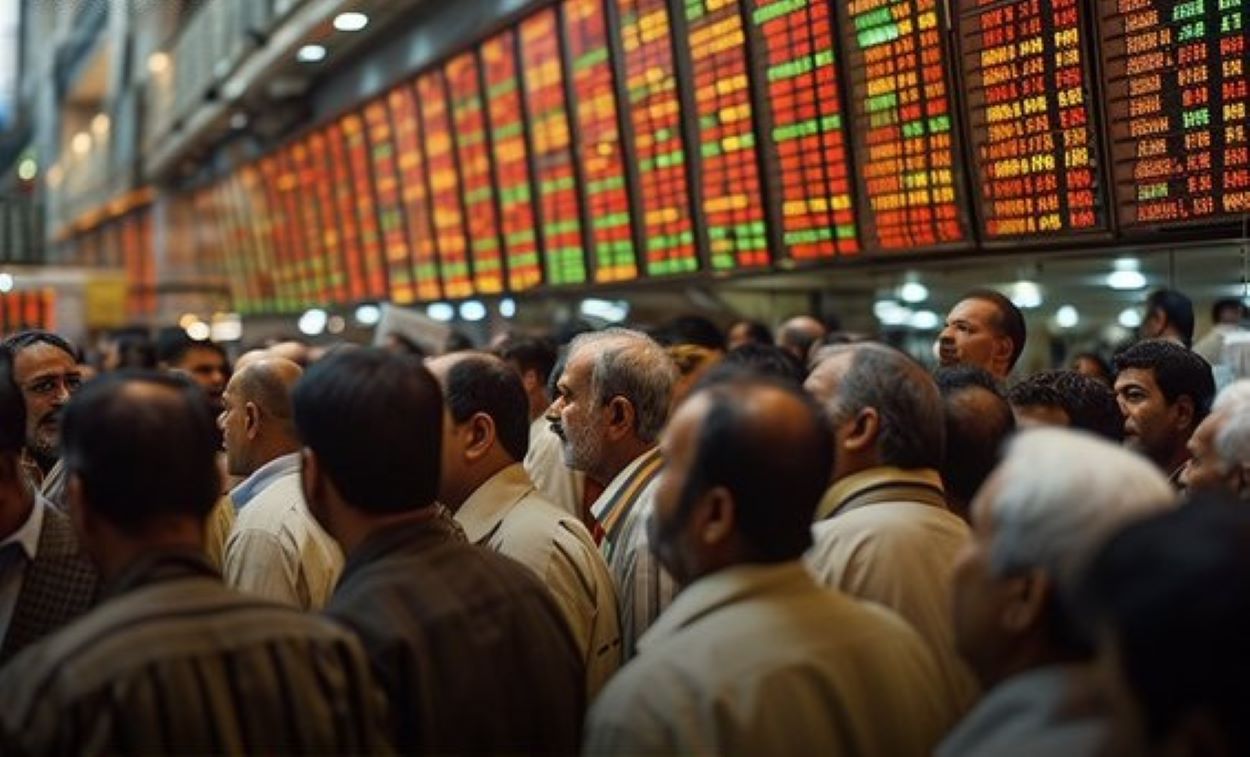

The PSX KSE-100 index decline extended into Tuesday as rising government bond yields and policy uncertainty weighed on investor confidence.
Based on the Pakistan Stock Exchange trade summary, the benchmark index traded between a high of 169,237.51 points and a low of 163,907.59, compared with the previous close of 167,691.08. The volatile session followed Monday’s sharp drop of 5,478.63 points.
Selling pressure intensified after a surge in government bond yields during the State Bank of Pakistan (SBP) auction last week. Policy tightening amid rising inflation and weaker earnings projections triggered broad-based losses.
The ongoing decline in the PSX KSE-100 index has also been influenced by external developments. Fresh US tariffs on imported goods came into effect after President Donald Trump moved to rebuild his trade agenda following a Supreme Court ruling.
Read: PSX KSE-100 Index Drops 3.16% as US-Iran Tensions Weigh on Market
The new duties, initially set at 10%, are described as a response to US balance-of-payments deficits. Trump has signalled a possible increase to 15%, while sector-specific tariffs on steel and automobiles remain in place.
At the same time, geopolitical tensions added to market caution. Trump stated he would decide within “10 or 15 days” whether to order strikes on Iran if nuclear talks fail. The US and Iran have held indirect discussions in Oman and Switzerland, with further talks scheduled.
Uncertainty over the outcome of Pakistan’s IMF third review talks also contributed to bearish sentiment.
Domestically, economic data presented mixed signals. Pakistan posted a current account surplus of $121 million in January, supported by strong remittances and lower imports. However, the cumulative position for 7MFY26 showed a deficit of $1.07 billion compared with a surplus a year earlier.
Meanwhile, weekly inflation measured by the Sensitive Price Indicator (SPI) rose 1.16% in the week ended February 19, with year-on-year inflation at 5.19%, according to the Pakistan Bureau of Statistics.
Market participants remain cautious as bond yields, global trade developments, and geopolitical risks continue to shape investor behaviour.