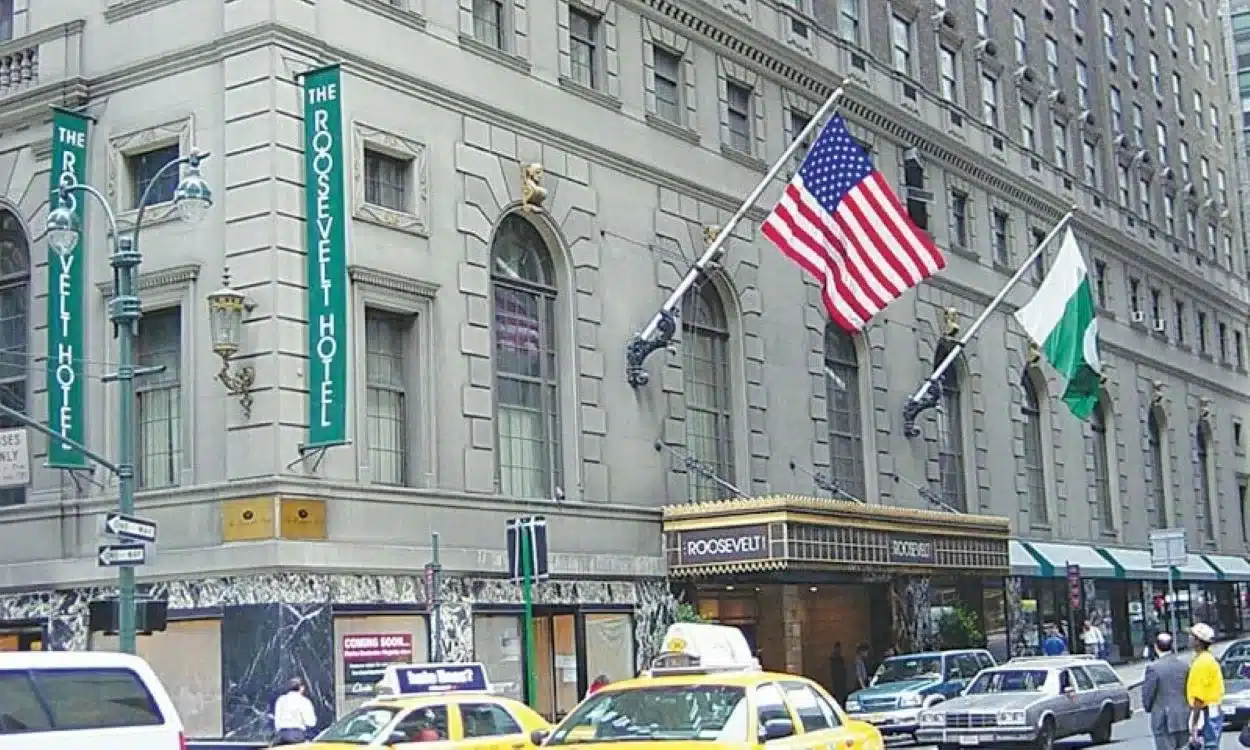

The Pakistan-US Roosevelt Hotel redevelopment agreement has been formally signed, marking a new phase in plans to renovate and reposition the historic New York property.
According to Pakistan’s Ministry of Finance, the governments of Pakistan and the United States have launched a strategic economic initiative in collaboration with the U.S. General Services Administration (GSA). The agreement covers the operation, maintenance, renovation, and redevelopment of the Roosevelt Hotel in New York.
A Memorandum of Understanding (MoU) was executed by GSA Administrator Edward C. Forst for the United States and Federal Minister for Finance and Revenue Senator Muhammad Aurangzeb for Pakistan. The signing was witnessed by Prime Minister Shehbaz Sharif and U.S. Special Envoy Steve Witkoff.
Pakistan US Roosevelt Hotel Redevelopment Agreement
The MoU establishes a structured, time-bound framework for assessing the project’s technical, commercial, and economic aspects. Officials stated that the framework aims to reduce risks, improve regulatory clarity, and maximise the property’s long-term value.
The initiative is aligned with Pakistan’s broader privatisation strategy and is intended to strengthen economic ties between Islamabad and Washington.
The Roosevelt Hotel has long been considered a strategic overseas asset for Pakistan. The new agreement signals renewed efforts to unlock its commercial potential through redevelopment.
Read: Privatisation Board Resets HBFC, Roosevelt Hotel Plans in Major Review Meeting
Earlier, the Privatisation Commission Board met in Islamabad to review major transactions, including the Roosevelt Hotel and House Building Finance Company Limited (HBFC).
During the meeting, the board recommended terminating the ongoing negotiated process for privatising a 51 percent stake in HBFC. Officials noted that only one bidder remained and that the submitted offer fell significantly below the approved reference price.
As a result, the board advised restarting the HBFC privatisation process.
The Roosevelt Hotel project, however, continues under the new MoU framework, focusing on evaluation and redevelopment rather than immediate asset disposal.