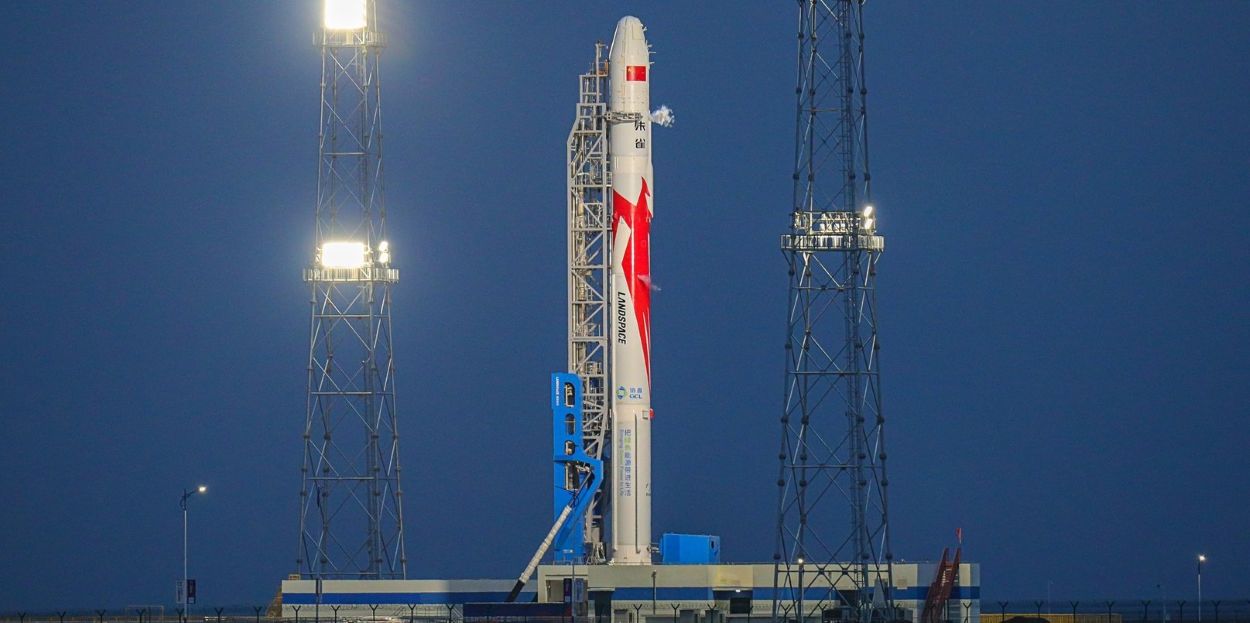

China’s commercial rocket startup LandSpace has never hidden its admiration for SpaceX. Earlier this month, the Beijing-based firm became the first Chinese company to attempt a reusable rocket recovery test, marking a significant milestone for the country’s private space sector.
The test, involving LandSpace’s Zhuque-3 rocket, did not succeed. However, the attempt itself has injected fresh momentum into China’s space industry, which for decades has been dominated by cautious, state-owned players. The move has also drawn attention from SpaceX, as LandSpace prepares to pursue an initial public offering to fund future projects, mirroring steps its larger US rival is considering.
LandSpace executives say SpaceX’s willingness to test aggressively and accept failure has shaped their thinking. Speaking to state broadcaster China Central Television, Zhuque-3 chief designer Dai Zheng said SpaceX’s approach of pushing designs to their limits allows engineers to learn quickly and refine systems faster.
Dai joined LandSpace in 2016 after leaving China’s main state-owned rocket developer, the China Academy of Launch Vehicle Technology. He said SpaceX’s focus on reusability and rapid iteration motivated him to help build a Chinese counterpart.
China's LandSpace gears up to take on Elon Musk and SpaceX https://t.co/jlQvILev3w https://t.co/jlQvILev3w
— Reuters (@Reuters) December 29, 2025LandSpace aims to give China a low-cost launch option similar to SpaceX’s flight-proven Falcon 9. That capability aligns with Beijing’s long-term plans to deploy satellite constellations numbering in the tens of thousands over the coming decades.
Zhuque-3 deputy chief designer Dong Kai said the company studied Falcon 9’s configuration closely. In a recent podcast, he described the design as rational and well tested, adding that learning from it should be viewed as engineering validation rather than imitation.
The startup’s culture is already influencing China’s broader space sector. State-led programmes have traditionally avoided public discussion of failures, unlike SpaceX and other Western firms that often broadcast test mishaps. This month, however, Chinese state media reported on the country’s first two failed attempts to recover reusable rockets, including one by a state-owned company, just weeks after Zhuque-3’s debut flight.
China’s Zhuque-3, developed by LandSpace, is a stainless-steel, methane-liquid-oxygen reusable rocket — 66 meters tall, 660 tons at liftoff, with an 18-ton payload to low Earth orbit (LEO).
If its first orbital launch succeeds this year, it could rival SpaceX’s Falcon 9. https://t.co/7F5XC0cfJ9 pic.twitter.com/JYVZgAl1Vs
— China Perspective (@China_Fact) October 24, 2025LandSpace has also increased transparency. It recently allowed Reuters access to its engine production facility, offering foreign media a rare look inside a core asset of China’s private space industry.
Beijing opened the space sector to private investment in 2014, paving the way for startups such as LandSpace. Authorities are now seeking to help leading firms access capital markets by easing pathways to public listings, a shift designed to support innovation in commercial spaceflight.
Read: Elon Musk Suggests SpaceX Could Go Public in 2026 IPO
Dai said SpaceX’s deep financial backing has enabled the US company to absorb heavy losses while testing its next-generation launch system, Starship. He acknowledged that Chinese startups do not yet have similar resources, but said policymakers increasingly recognise the need for market funding to support high-risk innovation.
SpaceX founder Elon Musk has already taken note of LandSpace’s work. In October, he commented on social media that Zhuque-3 appeared to combine elements of Starship, such as stainless steel construction and methane-based engines, with a Falcon 9-style architecture. Musk described the approach as potentially powerful, while stressing that Starship operates in a different league.
Features such as stainless-steel structures and Methalox engines are central to efforts by companies like SpaceX and LandSpace to reduce launch costs. Yet the most decisive saving comes from recovering and reusing the rocket’s first stage.
LandSpace plans another Zhuque-3 test after its December failure, when the booster could not ignite its landing burn about three kilometres above the ground and crashed instead of landing safely. Engineers say the company is drawing confidence from SpaceX’s early experience, noting that Falcon 9 achieved its first successful booster landing in 2015 after multiple failed attempts.