

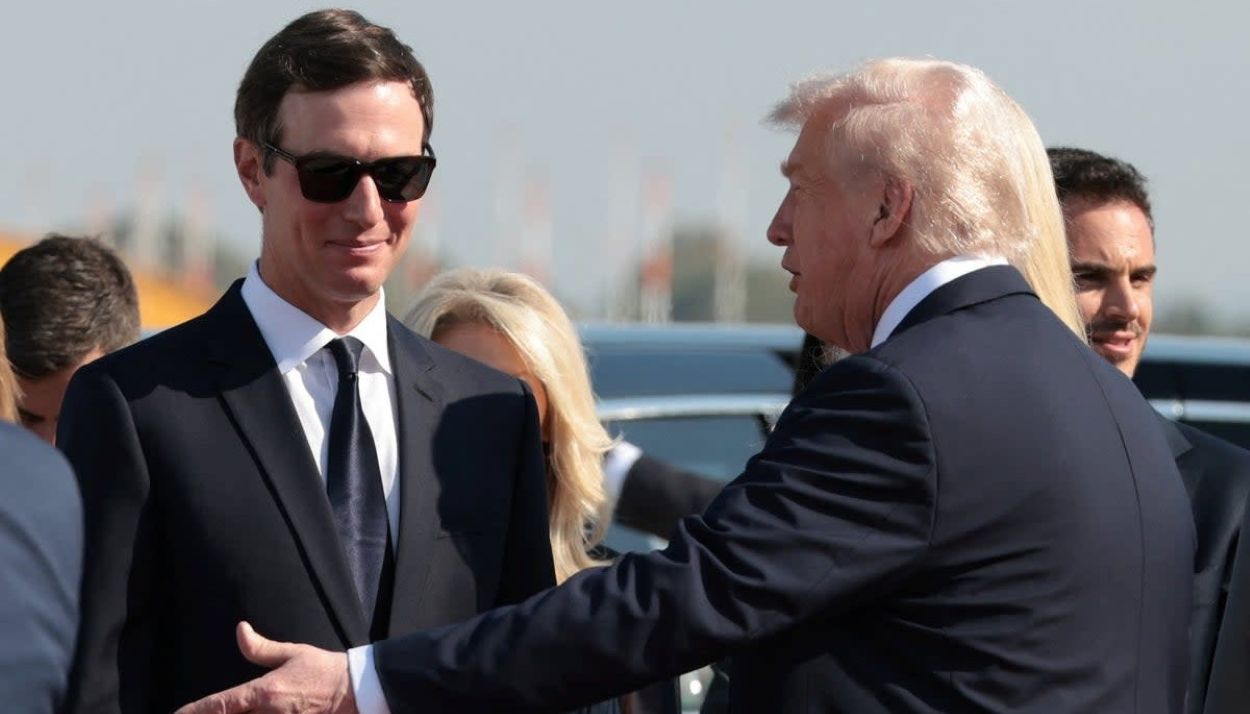

At the start of Donald Trump’s second term, Jared Kushner stayed out of government, choosing to focus on private business rather than return to the White House. Nearly a year later, that distance has narrowed as Kushner re-emerges in sensitive foreign policy negotiations.
Trump’s inner circle has drawn Kushner back into diplomacy as talks intensify on some of the world’s most difficult conflicts. Until recently, special envoy Steve Witkoff led most negotiations alone, despite having no prior government experience. Officials now say Kushner’s background helps balance Witkoff’s style and strengthens the administration’s ability to close deals.
That shift became clear over the weekend, when Kushner and Witkoff conducted a series of high-level meetings in Miami. On Sunday, they concluded two days of talks with Russian negotiator Kirill Dmitriev focused on proposals to end Russia’s war in Ukraine.
The discussions followed earlier meetings in Florida with the Ukrainian negotiating team, led by Rustem Umerov, along with senior national security officials from Britain, France, and Germany. European and Ukrainian representatives remained in the region for additional consultations with US officials facilitated by Trump’s envoys.
Trump is leaning on son-in-law Jared Kushner for difficult diplomacyhttps://t.co/yj3xahIWq6 pic.twitter.com/9dOnkWdh1m
— The Washington Times (@WashTimes) December 22, 2025Alongside the Ukraine talks, Kushner and Witkoff also met Turkish and Qatari officials to address the fragile truce between Israel and Hamas in Gaza. The meetings focused on advancing the second phase of Trump’s ceasefire plan.
Differing Styles, Shared Objectives
Officials describe Witkoff as an energetic and highly visible negotiator who frequently praises Trump’s foreign policy instincts. His approach has drawn mixed reactions abroad, particularly among Ukrainian and European officials who view him as overly accommodating toward Russian interests.
Kushner brings a different profile. He played a central role in the Abraham Accords during Trump’s first term and has firsthand experience navigating complex regional diplomacy. Some European officials remain cautious due to Kushner’s business ties in the Middle East, but many see him as a more credible counterpart at the negotiating table.
Ian Kelly, a former US ambassador to Georgia and now a diplomacy lecturer at Northwestern University, said Kushner’s record gives him added weight. However, Kelly cautioned that success remains uncertain while Witkoff continues to lead the Ukraine track.
Read: Trump Prepares Aggressive Immigration Crackdown With $170bn Funding
The White House has defended Kushner’s involvement. Deputy press secretary Anna Kelly said Trump views Kushner as a trusted adviser whose experience proves valuable during complex negotiations. She added that both Trump and Witkoff frequently seek Kushner’s input.
Trump is leaning on son-in-law Jared Kushner for difficult diplomacy https://t.co/tdofzqcFpz
— O.C. Register (@ocregister) December 21, 2025State Department spokesman Tommy Pigott described Kushner as a world-class negotiator and said Secretary of State Marco Rubio appreciates his willingness to assist on global challenges.
Scrutiny and Strategic Return
Kushner’s role has not escaped criticism. Some Democrats and oversight groups question his influence while he manages billions in investments through his firm, Affinity Partners, including funding linked to Saudi Arabia and Qatar. Witkoff has also faced scrutiny over business ties in the Gulf, including a cryptocurrency venture backed by a UAE-controlled fund.
Kushner has dismissed conflict-of-interest concerns, arguing that long-standing relationships strengthen diplomacy rather than undermine it. White House counsel David Warrington said Kushner’s advisory work complies fully with the law and noted his earlier contributions to landmark diplomatic breakthroughs.
For much of the year, Kushner stayed out of the spotlight. He declined a formal role in the administration while remaining available for advice. Officials say he resisted deeper involvement until negotiations on Gaza and Ukraine stalled.
As talks on the Israel-Hamas conflict faltered over the summer, Kushner stepped in and used his contacts from the Abraham Accords to help move Trump’s plan forward. The resulting framework, agreed to in late September around the UN General Assembly, remains a work in progress. Kushner and members of his earlier negotiating team now help coordinate its implementation.
Trump publicly acknowledged Kushner’s value after the agreement, telling Israel’s parliament that he turns to Kushner when he wants a deal closed. Shortly afterwards, Kushner said he planned to return to private life in Miami. That break proved brief.
Within weeks, Trump again called on his son-in-law to assist with the deadlocked Russia-Ukraine talks involving Vladimir Putin and Volodymyr Zelenskyy. The renewed role suggests Trump intends to rely on Kushner when negotiations reach their most critical stage.
For now, Kushner continues to operate as an informal but influential figure, stepping in when talks stall and stepping back when momentum returns. As Trump’s diplomatic ambitions expand, that role appears set to continue whenever the stakes rise highest.
*With additional information incorporated from Associated Press reporting



