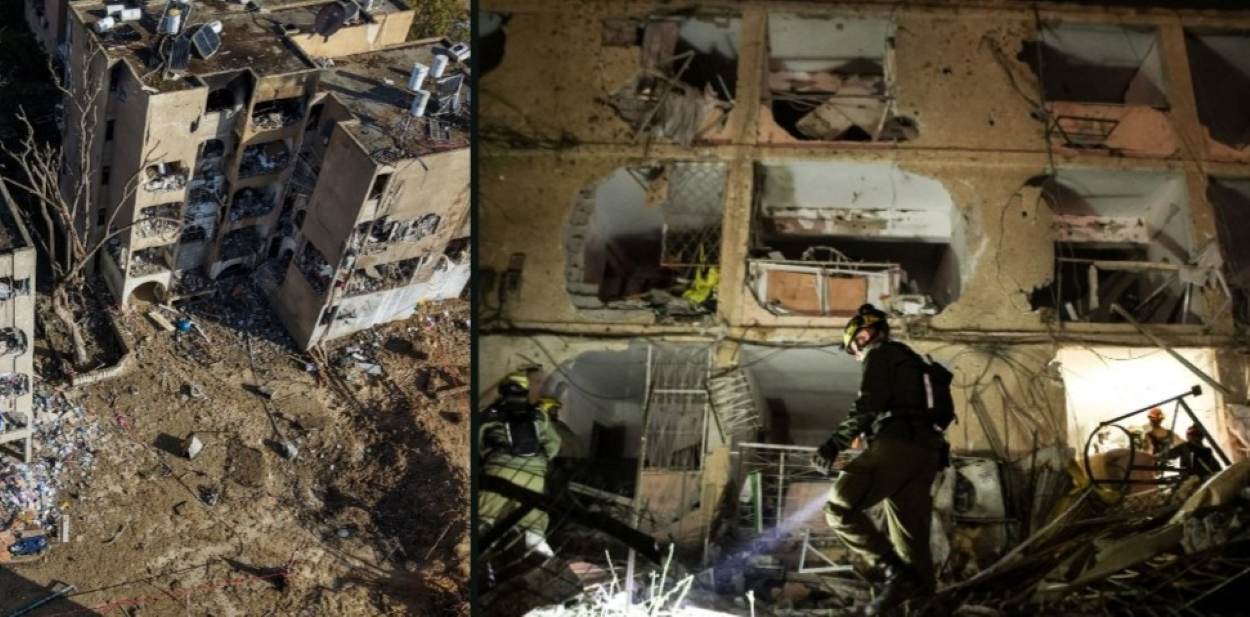

Iran’s missile strikes on Israel on Saturday caused widespread damage and injured more than 115 people in Arad and Dimona, the most destructive attack of the three-week conflict.
The strikes tore open the facades of residential buildings and carved craters into the ground. First responders reported 75 people injured in the town of Arad, 10 of them seriously. Hours earlier, an attack in nearby Dimona wounded 33 people. AFPTV footage showed a large crater carved into the ground, surrounded by piles of rubble and twisted metal.
Dimona hosts a facility widely believed to be the site of the Middle East’s only nuclear arsenal, though Israel has never officially acknowledged possessing nuclear weapons.
The Israeli military told AFP there had been a “direct missile hit on a building” in Dimona, with casualties reported at multiple sites. Among the injured was a 10-year-old boy in serious condition with shrapnel wounds.
In Arad, emergency workers combed through the rubble of heavily damaged buildings as rescue efforts continued.
A ballistic missile strikes Dimona, key to Israel’s nuclear program, injuring over 80, including a critically wounded child.
Iran says the strike was in retaliation for attacks on the Natanz uranium enrichment plant.
Al Jazeera's Rob McBride reports. pic.twitter.com/OproGjGusu
— Al Jazeera Breaking News (@AJENews) March 22, 2026Netanyahu described the attacks as “a very difficult evening” and pledged to continue striking Iran in response. Iran stated that targeting Dimona was retaliation for Israeli strikes on its Natanz nuclear facility.
Following the Natanz attack, UN nuclear watchdog chief Rafael Grossi reiterated his call for “military restraint to avoid any risk of a nuclear accident.” The Natanz facility houses underground centrifuges used to enrich uranium for Iran’s disputed nuclear program and sustained damage during the June 2025 war.
Read: Trump Signals US May Wind Down Military Operations Against Iran
When asked about Natanz, the Israeli military said it was “not aware of a strike.” However, the military also announced on Saturday that it had struck a facility inside a Tehran university “utilised by the Iranian terror regime’s military industries and ballistic missile array to develop nuclear weapon components.”
Iran Strikes Near Israeli Nuclear Site
Dimona, Arad hit in missile attack
– 115 people wounded in Arad
'We were hit by a large missile fired from Iran. It’s nothing short of a miracle that there have been no fatalities. Over 100 people have been injured, and more than… pic.twitter.com/M9maid10u5
— TIMES NOW (@TimesNow) March 22, 2026Strait of Hormuz Crisis Deepens
The destruction in Israel capped three weeks of heavy US-Israeli bombardment that has done little to blunt Iran’s ability to retaliate with missile and drone attacks across the region.
Iran has effectively choked off the Strait of Hormuz, through which approximately 20 percent of global crude oil flows during peacetime. US Central Command chief Admiral Brad Cooper said American warplanes dropped 5,000-pound bombs on an underground Iranian coastal facility storing anti-ship cruise missiles, leaving Tehran’s ability to threaten the waterway “degraded.”
A coalition of European and allied nations, including the UK, France, Italy, Germany, South Korea, Australia, the UAE, and Bahrain, condemned the “de facto closure of the Strait of Hormuz by Iranian forces” and expressed readiness to ensure safe passage.
Iran launched a ballistic missile attack on the US-UK base at Diego Garcia, an Indian Ocean island approximately 4,000 kilometres from Iran. A UK official told AFP the attack was “unsuccessful.”
If the salvo had reached its target, it would have marked Iran’s longest-range strike to date. Israel’s military chief, Eyal Zamir, said Iran launched a “two-stage intercontinental ballistic missile with a range of 4,000 kilometres.” He added, “These missiles are not intended to strike Israel; they can reach European capitals.”
*External Source: Chatham House analysis and AFP reporting