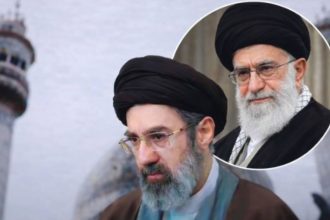
On Thursday, Iran observed the 40th day since Khamenei’s burial with nationwide mourning ceremonies, despite the absence of clear official information regarding the location or manner of former Supreme Leader Ali Khamenei’s interment amid a fragile two-week ceasefire between the United States and Israel, further heightening the sense of tension surrounding the occasion.
State media said mourning processions began in the morning across several cities and were due to continue until 8 p.m. Organised groups moved through urban centres as part of coordinated commemorations, 40 days after Khamenei’s killing on February 28.
Authorities confirmed Khamenei’s death the day after he was killed and announced 40 days of public mourning. However, officials have still not publicly clarified where he was buried or whether a formal burial has taken place.
That uncertainty has drawn attention because, in Shiite tradition, the fortieth day after death is closely connected to visits to a grave and large public gatherings. The absence of a confirmed burial site has therefore made this commemoration highly unusual.
A separate memorial held at Tehran’s Saint Sarkis Church on Wednesday sparked strong reactions online. The ceremony was attended by Culture Minister Abbas Salehi and stood out because of the unusual choice of venue for a figure so central to Iran’s Shiite political and religious establishment.
Many online comments mocked the event and questioned the lack of a confirmed burial. Others linked the moment to past state restrictions on public mourning, while some suggested the church venue may have been chosen for security reasons.
Ceasefire Forms the Backdrop to Ceremonies
The commemorations come just after 40 days of conflict that lasted until Tuesday night, followed by a temporary ceasefire. The truce between Tehran and Washington, backed by Israel, was reached after last-minute mediation by Pakistan.
Even so, tensions appear to remain high. The text notes that explosions and air defence activity were reported in multiple cities on Wednesday and Thursday night, while pro-government supporters have continued to gather and back official narratives.
Iranian authorities used the fortieth-day ceremonies to highlight continuity in the state’s political direction. The Islamic Revolutionary Guards Corps said in a statement that Khamenei’s death was as consequential as his life in advancing the Islamic Republic’s trajectory. That message suggests the state is trying to project stability even as questions over burial, public symbolism, and the ceasefire continue to shape the national mood.