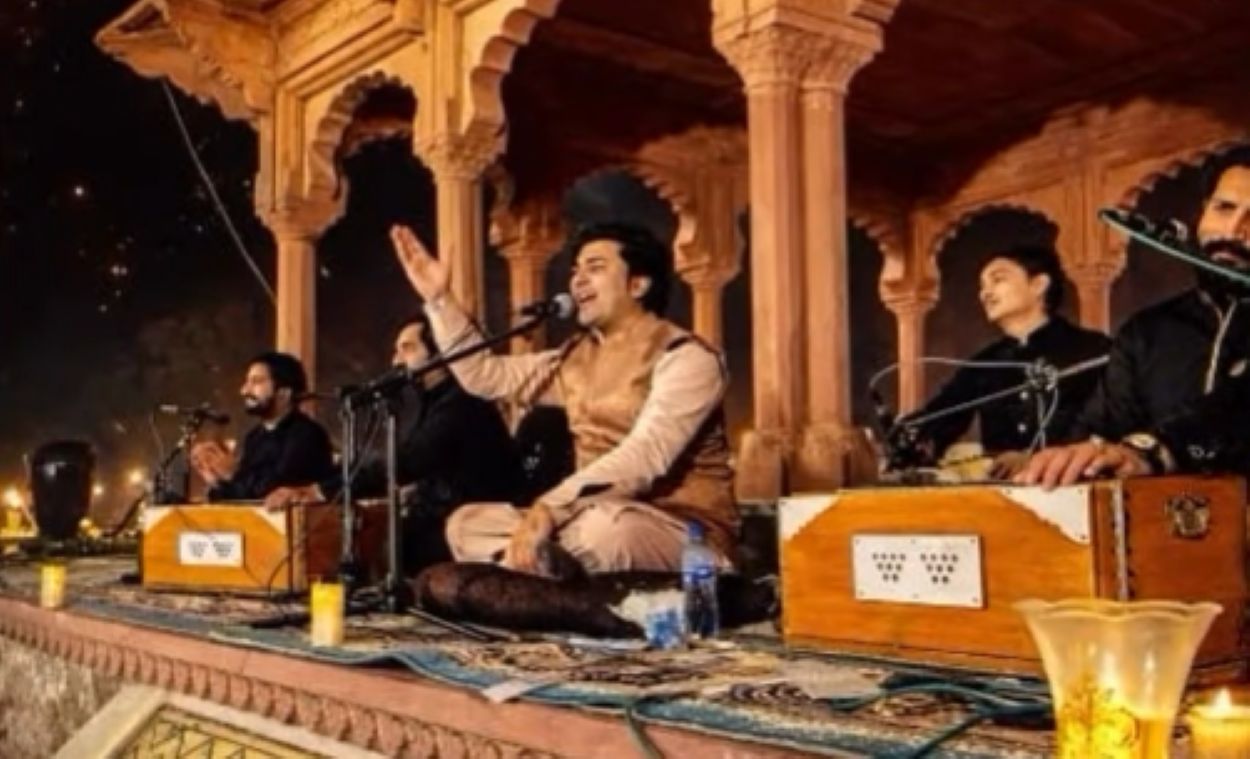

Police have registered a case against Qawwal Faraz Khan for performing a song linked to “Prisoner 804” during a government-backed cultural event at Shalimar Gardens, officials confirmed.
An additional sessions judge in Lahore granted Faraz Khan, whose full name is Faraz Amjad, interim bail until January 13. During the hearing, the singer told the court he would not have performed the song if he had known it would result in a criminal case. He said he never intended to create controversy or violate any rules.
According to the police report, the Walled City of Lahore Authority organised the musical and cultural night at Shalimar Gardens as part of an event titled Chandni Raatain. The programme aimed to promote culture, music, and harmony. It explicitly barred political content or slogans.
The FIR states that during the qawwali performance on February 3, Faraz Khan and fellow performers sang a song associated with “Adiala Jail prisoner 804” without permission. The administration stopped the performance soon after the song was played.
The case was registered at the Shalimar police station on a complaint from Zamir, the in-charge of Shalimar Gardens, under various sections of the Pakistan Penal Code. The complainant stated that the song generated excitement among the audience. This raised concerns about public order. The FIR further alleged that the performance underminedhttps://www.youtube.com/watch?v=5epWAHb6GWY the event’s non-political nature. It damaged the neutrality and credibility of a government institution.
Police described the act as irresponsible and beyond legal limits. They alleged it attempted to incite the public and politicise a state-run cultural programme. Faraz Khan, however, has maintained that he performed the song on audience demand and had no intention of violating the event’s guidelines.
The event was open to the public, and the incident has sparked renewed debate over artistic expression and the boundaries imposed on cultural programmes. Police said an investigation is underway. Authorities are reviewing the matter from multiple legal angles.
The case adds to a growing list of actions taken against artists and content creators over work deemed controversial. In recent years, several writers, satirists, and digital creators have faced legal action or detention over content critical of state institutions. This has prompted concerns from rights groups about shrinking space for expression.