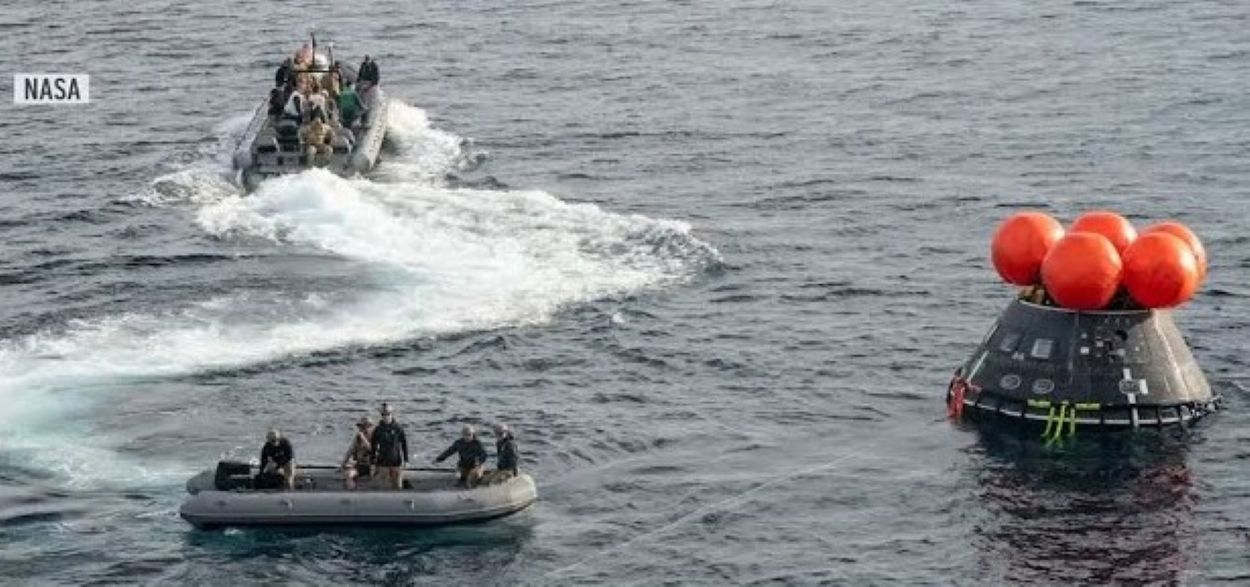

Artemis II splashdown safely brought NASA’s first crewed lunar flyby mission in 50 years to an end, as the Orion capsule returned to Earth after nearly 10 days in space. The mission marked a major step in NASA’s plan to send astronauts back to the moon and eventually push human exploration toward Mars.
The gumdrop-shaped Orion capsule, named Integrity, parachuted into the Pacific Ocean off the Southern California coast shortly after 5 p.m. PT on Friday. Its return capped a voyage that carried four astronauts farther from Earth than any humans had travelled before. The return to Earth was more than a symbolic milestone. It also served as a crucial test of the Lockheed Martin-built Orion spacecraft, especially its heat shield during re-entry from a lunar-return trajectory.
Orion's main parachute has deployed. The spacecraft has a system of 11 chutes that will slow it down from around 300 mph to 20 mph for splashdown.
Get more updates on the Artemis II blog: https://t.co/7gicm7DWBt pic.twitter.com/ReXHTfkFld
— NASA (@NASA) April 11, 2026During a 13-minute descent through Earth’s atmosphere, the capsule faced extreme friction and heat. Temperatures on the exterior reached around 5,000 degrees Fahrenheit, while the plasma surrounding the vehicle caused a temporary communications blackout.
NASA later regained contact as parachutes opened and slowed Orion’s descent to about 15 mph before it gently hit the water. Recovery teams were then expected to secure the capsule and assist the crew out for initial medical checks.
The Artemis II crew included NASA astronauts Reid Wiseman, Victor Glover and Christina Koch, along with Canadian astronaut Jeremy Hansen. The mission also marked several notable firsts in the history of lunar exploration. Glover became the first Black astronaut, Koch the first woman, and Hansen the first non-US citizen to take part in a lunar mission. Their spacecraft reached a point 252,756 miles from Earth, surpassing the previous record set by Apollo 13 in 1970.
Welcome home Reid, Victor, Christina, and Jeremy! 🫶
The Artemis II astronauts have splashed down at 8:07pm ET (0007 UTC April 11), bringing their historic 10-day mission around the Moon to an end. pic.twitter.com/1yjAgHEOYl
— NASA (@NASA) April 11, 2026The crew launched from Cape Canaveral on April 1 aboard NASA’s Space Launch System rocket before heading toward a lunar flyby. The mission followed the uncrewed Artemis I test flight in 2022 and now serves as a dress rehearsal for a later attempt to land astronauts on the moon. NASA’s broader aim is to establish a long-term human presence on the moon as a stepping stone to a human presence on Mars. That makes Artemis II an important validation mission, not only for the Orion spacecraft but also for the Space Launch System and its contractors.
Read: Artemis II Astronauts Share Call with ISS Crew
One of the most important engineering questions involved Orion’s heat shield. Engineers changed the descent path for Artemis II after the spacecraft’s 2022 test flight revealed unexpected levels of scorching and stress during re-entry. This time, the safe splashdown suggested those adjustments worked. That outcome could strengthen confidence in NASA’s timeline for future Artemis missions and its long-term lunar ambitions.