

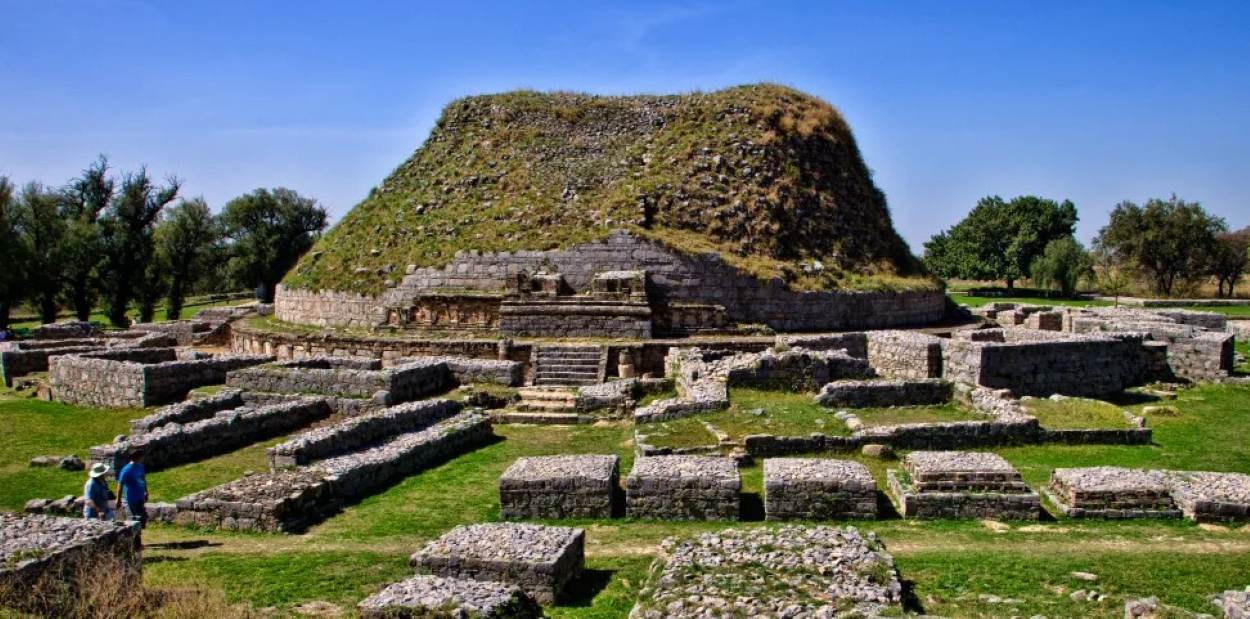

Archaeologists recently uncovered glass beads at Taxila’s Bhir Mound during excavations at one of the valley’s oldest urban sites. Officials found 18 beads at the historic mound and, based on preliminary dating, placed them between the early 2nd century BC and the 1st century AD.
The team made the discovery at Bhir Mound, which marks the first city of the Taxila valley civilisation. The Bactrian Greeks later abandoned the site between the 1st century BC and the 2nd century AD, during the final known phase of its settlement.
Aasim Dogar, Deputy Director of the Punjab Department of Archaeology, leads the five-member excavation team. He said the team found the beads in trench H-3 at a depth of 14 inches below the surface. He added that the find appears to be part of a necklace, with the thread having decayed over time, but the beads remaining intact.
Dogar said a preliminary study places the artefacts in the late Maurya period and the earliest Greek era in Taxila. He also noted that Sir John Marshall had previously found similar glass beads during excavations at Sirkap between 1913 and 1934.
The beads point to the advanced craft traditions of ancient Gandhara, including early expertise in metalworking and glass production. Their presence also suggests that Taxila was not only a cultural and educational centre but also an important industrial and commercial hub in ancient South Asia. Dogar said traders widely exchanged Taxila’s beads across Central Asia and the Indian subcontinent. However, he cautioned that researchers still need laboratory testing and contextual analysis before they can draw final conclusions.
The excavation team is using Japanese and Chinese software and hardware, including GPS tools, drone surveys, 3D scanning and digital mapping. Dogar said these technologies have improved excavation and conservation work in Taxila.
The key excavation and quarrying equipment was provided by the Japanese government through JICA as part of a project to improve exhibition and conservation at the Taxila Museum. The project was implemented with a Japanese grant of 48.8 million yen in February this year.
Bhir Mound forms part of the Ruins of Taxila, which were inscribed as a Unesco World Heritage Site in 1980. Historical accounts also cited in the link the ancient city to figures such as Panini, Caraka and Kautilya.



